Volkswagen Touran
New Touran as TDI consumes just 4.6 litres per 100 km with BlueMotion Technology!
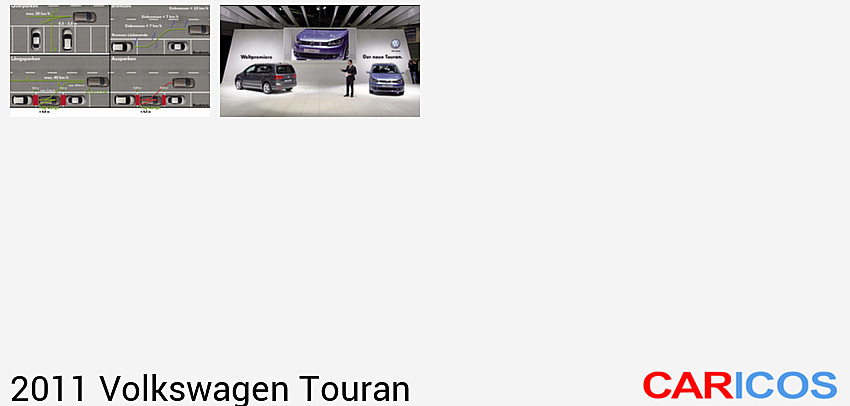
The Touran from Volkswagen is the most successful German compact MPV and “the” consummate family vehicle. Exactly 1.13 million units of the Touran have been sold to date. In Germany, it currently holds a market share of nearly 50 percent in its segment and across Europe, the Volkswagen ranks among the top five in its class. At the Auto Mobil International in Leipzig (10 to 18 April), Volkswagen is now presenting a generation of the bestseller that has been redesigned in many areas. The look of the Touran now follows the updated Volkswagen “design DNA”. From a technical viewpoint, its progressive systems break through class boundaries, as in the case of the continuous main beam headlights (Dynamic Light Assist) being introduced on an MPV for the first time, and the new Park Assist 2.0 for nearly automatic parallel and diagonal parking. A full range of six new petrol and diesel engines point the way to fuel economy and emis sions values which were previously inconceivable on an MPV. Setting the pace in sustainability is the Touran TDI BlueMotion Technology (77 kW /105 PS): The Touran sets a new best value for a seven-seater MPV with combined fuel consumption of 4.6 l/100 km (equivalent to 121 g/km CO2).
Also new aboard the Touran is the innovative entry-level petrol engine, the 1.2-litre TSI. It is a turbocharged direct-injection engine with 105 PS. In the style of a turbodiesel, it develops a strong 175 Newton-metres of torque from just above idle speed, yet it consumes only 6.4 l/100 km fuel in combined mode (equivalent to 149 g/km CO2). As an alter native, this variant is also available with BlueMotion Technology – together with the Start/Stop system and battery regeneration. In this case, values for combined fuel consumption and CO2 emissions are reduced to 5.9 l/100 km and 139 g/km, respectively.
All eight engines (power range from 66 kW/90 PS to 125 kW/170 PS) are highly efficient. Without exception, they are turbocharged directinjec tion engines, which follow the Volkswagen downsizing principle. And this means: less engine displacement, lower emissions, lower fuel consumption yet significantly more torque! Naturally, all new Tourans fulfil the requirements of the Euro-5 emissions standard.
The range of features on the multi-purpose vehicle - equipped with up to 39 storage options - was reconfigured as well. The base model is now the Touran Trendline (previously Conceptline). Fuel consumption of the standard 1.2-litre TSI is frugal. Yet, the base model’s standard features are anything but frugal; they include air conditioning, radio/CD system with MP3 function, electric windows in all four doors, elegant decorative inserts in “Brushed Chrome” and daytime running lights.
Launching with an even more exclusive package of features is the Touran Comfortline (including light and rain sensors; automatic dimming rear-view mirror; chrome accents on components such as the light switch, window and mirror adjustment controls; light-absorbing side windows; comfort seats in front; folding tables for the second row of seats and black roof rails). The exclusive top model is the Touran Highline; its additional features - in addition to the Comfortline’s features - include Alcantara fabric upholstery, sport seats (front), automatic climate control, multifunction display with colour screen, leather-trimmed steering wheel with multifunction keys, 16-inch alloy wheels, silver roof rails and front fog lights with chrome frames.
Now on the Touran for the first time is the new RNS 315 radio- navi ga tion system with touchscreen. Other new optional features now available include: the enormous panoramic slide/vent sunroof, Rear-View camera (standard in conjunction with RNS 510 radio-navigation sys tem) and the DCC dynamic chassis control system. Another new feature on the Touran is Light Assist – an automatic main beam control system for standard headlights, making them a “younger technological sister” of the Dynamic Light Assist developed for bi-xenon headlights.
The Touran will launch in August in Germany; over the course of the autumn, it will gradually be introduced to markets across the globe.
TDI and TSI engines – perfected downsizing
The range of engines – all turbocharged direct-injection four- cylinder units - should satisfy nearly all wishes. On the petrol side, three TSIs are being employed. As mentioned, the entry-level engine is the new 1.2-litre TSI with 77 kW/105 PS. The two 1.4-litre TSI engines were adopted from the previous model; they have power outputs of 103 kW/140 PS and 125 kW/170 PS. The 170 PS version is paired with a standard seven-speed Direct Shift Gearbox; on the 140 PS TSI this extreme ly fast operating automatic gearbox can be ordered at extra charge.
Still a unique offering in this market segment is the EcoFuel, which consumes only 4.7 kilograms of natural gas (CNG) per 100 kilo metres in combined mode driving; and that is equivalent to CO2 emissions of 128 g/km. When combined with the optional seven-speed Direct Shift Gearbox (this combination is also unique among MPVs), fuel con sum ption is reduced to 4.6 kg/100 km and CO2 emissions to 125 g/km.
Four new turbodiesels in the Touran – all of them now equipped with common rail direct-injection that is as efficient as it is smooth running – complete the engine line-up. Although their power values match those of the previous model, they are completely new TDIs in which Volkswagen has attained significant fuel savings. The entry- level engi ne of the TDI quartet is a 1.6-litre four cylinder with 66 kW/90 PS. Its com bi ned fuel consumption (5.1 litres) represents a fuel saving of 0.9 l/100 km compared to the previous model. At the next power level up, there is a 1.6-litre variant with 77 kW/105 PS. Upon request, this TDI may be ordered with a seven-speed DSG or in the BlueMotion Techno lo gy version (six-speed manual). As mentioned, thanks to BlueMotion Technology the Touran TDI sets a new best fuel economy value for seven-seater MPVs at 4.6 l/100 km. The two most powerful TDIs with 103 kW/140 PS and 125 kW/170 PS are 2.0-litre engines. Here too, fuel savings were reali sed in the new genera tion: up to 1.2 l/100 km. The 170 PS TDI has a standard six-speed DSG, while DSG is offered as an option on the 140 PS variant. Like the 105 PS TDI, customers can order the 140 PS TDI with BlueMotion Techno logy starting at the end of this year. Combined fuel con sumption here is 4.8 l/100 km. Except for models that come with standard DSG, a six-speed manual gearbox is provided in all Tourans.
Body styling and functionality – DNA of a new generation
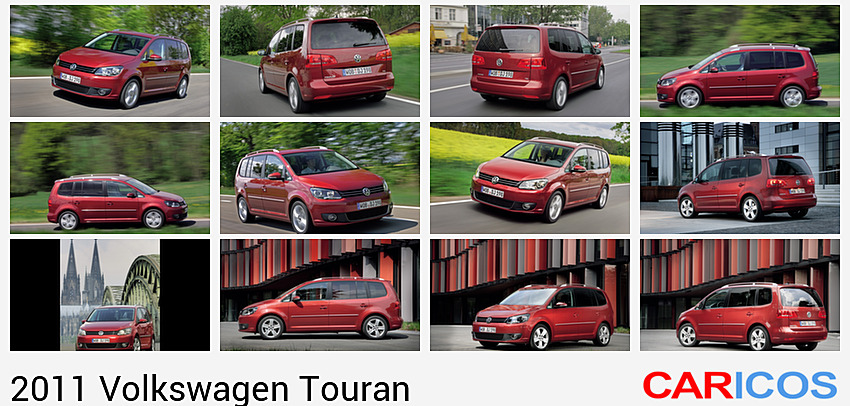
The MPV’s new styling sharpens the character of the new generation Touran. Except for the four doors, every other body part of the MPV was restyled. As on the latest generation of the larger Sharan, and the even larger Multivan, a clear network of horizontal lines do minates in its styling. This adds to the Touran’s high stature within its class. Consi der the front end: Here the bumper, radiator grille, engine bonnet, wings and headlights are equipped 100 percent with the latest Volkswagen “design DNA”. High-end: the individualised radiator grille in glossy black with chrome trim is standard in some versions. Timeless: the larger yet elegant bumpers are painted in body colour. Pioneering: the dis tinctive shapes of the headlights. Their functionality can be ex ten ded to include automatic main beam activation when the Light Assist option is ordered, or – in the case of bi-xenon headlights and a world first in this class – continuous activation of the main beam headlights with the Dynamic Light Assist option. When customers order their Tourans with bi-xenon headlights, an LED daytime running light and position light – also a new development - is added to the headlight module. It consists of 12 individual LEDs.
Specifics on Light Assist and Dynamic Light Assist: The Light Assist function was designed for the standard headlights of the new Touran. As a camera-based system, this main beam assistant (extra option) reco gnises traffic situations based on detected light sources and gives either a dipped beam or main beam command to the power control module. The main beam is automatically activated or deactivated (starting at 60 km/h) based on this command; this functionality offers clear gains in convenience and safety.
For even better illumination of the road and road markings, the Dynamic Light Assist system was developed for bi-xenon headlights with integrated cornering light and dipped beam light. Also thanks to a camera integrated behind the front windscreen, this system makes it possible to keep the main beam modules of the bi-xenon headlights continually active. They are only masked in light pattern areas in which the system’s analysis shows a potential for unwanted glare to other vehicles in traffic.
The rear section of the Touran was also restyled for greater elegance. Along with the new horizontal structure of its design surfaces, it is the MPV’s rear lights – designed for the first time as two-part modules – that are especially prominent. They extend from the wing into the tailgate. Distinctive styling of the light module’s interior gives the Touran an unmistakable daytime and nighttime look. In addition, the tailgate offers advantages in terms of aerodynamics and functionality. A restyled roof edge spoiler reduces air turbulence in the rear section and helps to lower the new Touran’s Cd value from 0.32 to 0.29. The tailgate itself is significantly easier to close; thanks to optimised kinematics of the gas springs it now closes gently in one swing. In addition, the larger rear window offers an even better view to the rear. The sides of the Touran’s rear section were modified as well; in its side profile, a character line known as the “tornado line” rises upwards from the C-pillars to the rear, intensifying the dynamic energy of body surfaces here.
Interior concept and features – cleverly thought out
In the interior, the new generation Touran being presented in Leipzig comes with new materials, instruments, decorative accents and controls.
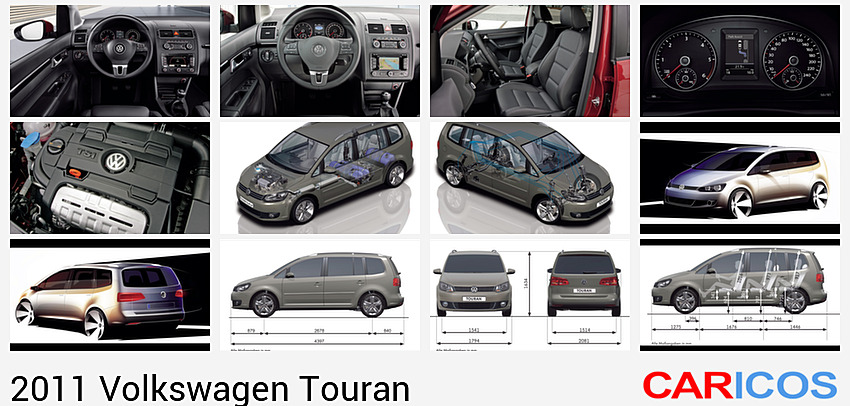
The centre console with its new air conditioning controls was visually restyled, and air vents now have chrome bezels. From the Comfortline equipment level, additional chrome accents trim interior compo nents such as switches for the electric windows, mirror adjustment and the light switch. Moreover, Volkswagen will be equipping the new Touran in the style of Golf & Co.; it will now have white backlit ins tru ments and new three-spoke steering wheels. On DSG versions, the gearshift grip and gate were restyled as well. Modified head restraints in the second and third seating rows – which now lower to a lower level when not in use – also offer improved visibility to the rear.
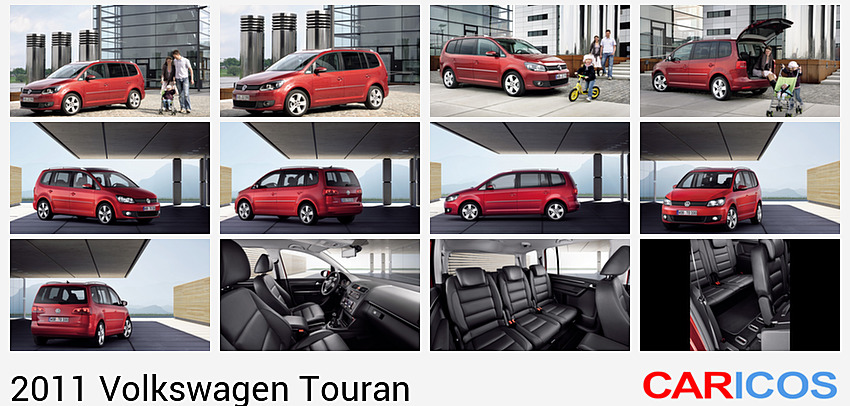
In terms of both its ergonomics and variability, the individual seating system impresses on the Touran – which comes with standard five seating positions and optionally with seven seats. The three second row seats that are arranged next to one another can be adjusted longi tudi nally folded together with just a few hand movements, re moved or shifted laterally. Due to their relatively high positions, the seats also offer excep tional thigh support and as a result excellent comfort on long journeys. Practical: Pockets and folding tables including a cup holder in the back of the driver and front passenger seats (from Comfortline), the middle seat that can be used as a table, storage bins in the floor in front of the second row seats and under the front seats, as well as large sized storage bins in the doors. The front passenger seatback may also be folded down completely, making it possible to transport long cargo objects.
As an option, the Touran can be ordered with a third seating row; when needed, it is easy to separately fold out each of the two full-size indi vi dual seats from the cargo area floor with just a few hand movements. In the lowered state, the cargo floor height is just seven centimetres more than without the third row of seats.
Optimal space utilisation in the Touran also extends to the bootspace. Storage compartments in the side walls of the cargo area and in the cargo floor can be used to secure numerous items. Even the warning triangle has a separate, newly designed storage compartment. For impro ved protection of cargo items of all types, the side walls of the bootspace were also redesigned and upholstered with carpeting.
In the classic five-seat configuration, the luggage section can handle up to 695 litres of cargo, and the maximum payload – depending on the version – is up to 660 kilograms. When all of the second row seats are removed and the third row seats are lowered, the maximum cargo capacity increases to 1,913 litres; on the five-seater with the second row seats removed, it is a full 1,989 litres. This means that new generation Touran owners will never have to face transport problems. And that is how it should be.