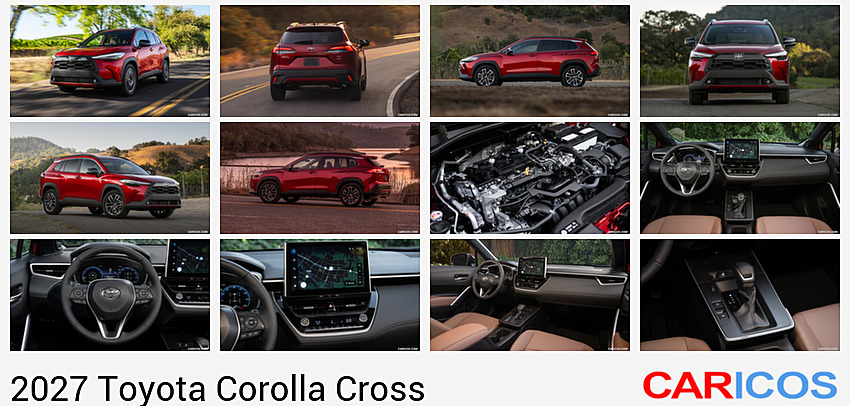
2027 Toyota Corolla Cross Drops Its Base Hybrid
The 2027 Toyota Corolla Cross carries over with one meaningful change: Toyota has dropped the entry-level Hybrid S, leaving SE and XSE as the only electrified trims. The gas-powered L, LE, and XLE continue alongside them, with the rest of the lineup retaining last year's equipment and specifications. That makes this a range adjustment rather than a redesign, and it removes the least-equipped route into the hybrid.
Pricing starts at $25,535 for the Corolla Cross L with front-wheel drive and $31,415 for the Hybrid SE, before Toyota's dealer processing and handling charge. Toyota expects U.S. dealerships to receive the 2027 models in fall 2026. Now entering its sixth model year, the small SUV continues to come from Huntsville, Alabama.
Two Faces for the Same Small SUV
The Corolla Cross shares Toyota's TNGA-C architecture and a family connection with the Toyota Corolla, but its taller body and higher seating position give it a more conventional SUV profile. Upright proportions, substantial wheel-arch cladding, and relatively restrained body creases favor familiarity over experimentation.
Toyota gives the gas and hybrid versions noticeably different front ends. Gas models use a broader, darker grille and a more traditional bumper arrangement. The hybrid's body-colored nose incorporates small honeycomb openings, narrow headlights, and vertical outer vents. It looks cleaner and somewhat less heavy-handed, although the large black lower bumper still occupies plenty of visual space.
A black roof and dark wheels sharpen the hybrid's appearance without changing its basic shape. At the rear, horizontally arranged taillights help visually widen the body, while thick lower cladding reinforces the SUV styling. Neither version tries particularly hard to disguise its practical proportions, which suits the vehicle.
Depending on trim, single-color choices include Celestite, Jet Black, Wind Chill Pearl, Soul Red Crystal, Cavalry Blue, Sonic Silver, and Cypress. Four combinations pair a Jet Black roof with Wind Chill Pearl, Cavalry Blue, Soul Red Crystal, or Sonic Silver. Toyota charges extra for the two-tone finishes, as well as the single-color Wind Chill Pearl and Soul Red Crystal paints.

Gas or Hybrid Changes More Than Fuel Economy
The gas-powered 2027 Corolla Cross uses a 2.0-liter, DOHC, 16-valve four-cylinder producing 169 horsepower. Its transmission incorporates a physical first gear for launches. Buyers can choose front-wheel drive or Toyota's Dynamic Torque Control AWD on every gas trim.
That gas AWD system can send up to 50 percent of available power rearward when conditions require additional traction. It also disconnects the rear driveline when it is unnecessary, reducing the efficiency penalty associated with driving all four wheels. Toyota estimates fuel economy at 30 mpg city, 32 highway, and 31 combined for front-drive models, versus 29 city, 31 highway, and 30 combined with AWD.
The 2027 Toyota Corolla Cross Hybrid combines Toyota's fifth-generation hybrid system with standard electronic on-demand AWD and 196 total system horsepower. That gives it a 27-hp advantage over the gas model, rather than asking buyers to trade output for lower fuel consumption. Its EPA-estimated combined rating reaches 42 mpg, with Toyota listing 46 mpg city and 39 highway.
A rear-mounted interior permanent-magnet electric motor supplies the hybrid's rear-wheel drive. The system can engage that motor during takeoff before the front tires slip, respond when they lose traction, and help limit understeer through corners. Unlike the gas version's AWD arrangement, it uses electric propulsion at the rear axle.
Toyota lists a 1,500-pound towing capacity for front- and all-wheel-drive configurations. That permits light-duty trailer use, but the rating places a fairly clear boundary around the Corolla Cross's utility ambitions.
A Cabin That Keeps Familiar Controls
The interior favors a straightforward layout over a screen-dominated dashboard. A freestanding central display sits above the vents, and a conventional shift lever occupies the console. There's still physical climate controls beneath the touchscreen, a small detail I appreciate more than another strip of decorative trim. Contrasting upholstery and slim metallic-look accents add some warmth to the otherwise dark dashboard.
Storage areas in the console, center stack, and doors provide places for smaller items. The rear seat folds in a 60/40 split to accommodate longer cargo while retaining a passenger seat, and rear HVAC vents come standard. Toyota also offers wireless phone charging, a larger central screen, and a fully digital instrument display, though those features depend on trim or options.
What the Gas Trims Include
L: The entry model combines cloth upholstery with an 8-inch Toyota Audio Multimedia touchscreen, wireless Apple CarPlay and Android Auto, and a three-month SiriusXM trial. Analog instruments accompany a 7-inch color information display. Other equipment includes remote keyless entry, two front USB-C charging ports, rear ventilation outlets, LED headlights and taillights, and 17-inch steel wheels with silver covers. Toyota Safety Sense 3.0 comes standard here, as it does throughout the range.
LE: Moving up adds 17-inch silver-painted alloy wheels, roof rails, a leather-wrapped steering wheel, automatic climate control, and Smart Key access with push-button starting. Qi wireless charging and four total USB-C ports expand the cabin's charging options. Body-colored heated power mirrors incorporate turn signals, while blind-spot monitoring and rear cross-traffic alerts add coverage beyond the standard driver-assistance package.
XLE: The top gas trim brings 18-inch machined-finish alloy wheels, LED daytime running lights, fog lights, a 10.5-inch touchscreen, and a 12.3-inch digital instrument cluster. SofTex synthetic upholstery covers the seats, with heating up front and a 10-way power driver's seat that includes lumbar adjustment. Dual-zone climate control, a folding rear armrest with two cupholders, a HomeLink-equipped rearview mirror, a leather-trimmed shift knob, and a cargo cover round out the cabin upgrades. Rear cross-traffic braking and front and rear parking assistance with automatic braking also join the equipment list.

The Hybrid Now Starts at SE
Hybrid SE: The remaining entry hybrid pairs its standard AWD system with 17-inch machined-finish alloy wheels, black roof rails, rear privacy glass, and gloss-black heated power mirrors. A darkened front Toyota emblem distinguishes the hybrid nose, while the rear spoiler and door handles match the body color. A rear wiper also comes standard.
Inside, the SE provides cloth seats, a six-way manually adjustable driver's seat, a four-way adjustable passenger seat, and a leather-wrapped steering wheel with paddle shifters. Its 8-inch touchscreen and analog instruments with a 7-inch information display mirror the lower gas trims' basic screen arrangement. Single-zone automatic climate control, rear vents, Qi charging, and four USB-C ports, split evenly between the front and rear, handle the everyday convenience duties. Blind-spot monitoring and rear cross-traffic alerts also come included.
Hybrid XSE: The upper hybrid trim switches to 18-inch black-finished alloy wheels and SofTex-trimmed mixed-material seating. It also gains the 10.5-inch touchscreen, 12.3-inch digital instrument cluster, dual-zone climate control, ambient lighting, a HomeLink rearview mirror, and a cargo cover. Rear passengers receive a folding center armrest with two cupholders.
Options Fill Some Equipment Gaps
LE and Hybrid SE buyers can order the Multimedia Upgrade package to replace the standard screen with the 10.5-inch unit. A separate Moonroof package adds a moonroof and cargo cover to those same trims. The Cold-Weather package supplies heated front seats and a heated steering wheel, but Toyota limits it to the gas LE AWD and Hybrid SE.
For the XLE and Hybrid XSE, the Convenience package combines a moonroof with a power liftgate. Those two upper trims also offer JBL audio with nine speakers, including a subwoofer, plus an amplifier. The standard sound system uses six speakers.
The package structure matters here. Choosing an upper trim does not automatically bring a power liftgate or moonroof, and front-drive LE buyers cannot select the listed Cold-Weather package. Those are useful distinctions to check before treating the trim names as a complete equipment guide.
Screens and Connected Services
Toyota Connected North America developed the Corolla Cross's multimedia system in Texas. Wireless Apple CarPlay and Android Auto eliminate the need for a cable for compatible smartphone integration, regardless of whether buyers choose the 8-inch or 10.5-inch screen.
The L, LE, and Hybrid SE use their 7-inch information displays to present fuel economy, trip data, driver-assistance information, and warnings alongside analog gauges. The XLE and Hybrid XSE replace that arrangement with a 12.3-inch digital cluster.
Every 2027 Corolla Cross includes five-year trials for Safety Connect and Service Connect, plus a 30-day/3-GB Wi-Fi Connect trial. All trims except the L also receive a five-year Remote Connect trial. With an active trial or subscription, owners can use the Toyota app to locate the vehicle, start its engine, or lock its doors remotely.
Additional services, including Drive Connect, vary by trim. Connected functions depend on 4G network availability, and continued access requires a subscription after the relevant trial expires. The lengthy included periods soften that expense initially, but buyers should distinguish built-in equipment from services that eventually carry a recurring charge.

Driver Assistance Across the Range
Toyota Safety Sense 3.0 comes standard on every gas and hybrid model. The suite includes forward pre-collision assistance with pedestrian detection, full-speed adaptive cruise control, lane-departure alerts with steering assistance, Lane Tracing Assist, road-sign recognition, automatic high beams, and Proactive Driving Assist. Toyota also includes its Star Safety System throughout the lineup.
The LE, XLE, Hybrid SE, and Hybrid XSE add blind-spot monitoring, rear cross-traffic alerts, and Safe Exit Alert. The base L misses those features, so its standard safety equipment does not quite match the rest of the range. The gas XLE goes further with the previously noted rear cross-traffic braking and automatic braking support for front and rear parking maneuvers.
Warranty and Included Maintenance
Toyota provides a three-year/36,000-mile basic warranty, excluding routine maintenance and normal wear items. Powertrain coverage runs five years or 60,000 miles, while corrosion coverage lasts five years without a mileage limit. Toyota lists eight-year/100,000-mile protection for electric-drive components, including the traction battery, with the time or mileage limit applying when reached first.
ToyotaCare covers scheduled factory maintenance for one year or 10,000 miles, whichever comes first. Roadside assistance extends for three years with no mileage cap. The different durations deserve attention: the roadside benefit continues well beyond the included maintenance period.
A Familiar SUV With a Higher Hybrid Entry Point
The 2027 Toyota Corolla Cross remains a straightforward small SUV with two meaningfully different powertrain choices. The gas version preserves the lower starting price, while the hybrid combines more horsepower, standard AWD, and substantially better city fuel economy. Its advantage extends beyond a badge or a different grille.
Dropping the Hybrid S narrows the buying decision, but it also removes a lower-equipment choice. The remaining Hybrid SE starts $5,880 above the front-drive gas L, although that comparison includes differences in both equipment and driven wheels. For 2027, the important question is less about what's new and more about which combination of efficiency, traction, and cabin features merits the added cost.
-Ed
 2027 Toyota Corolla Cross