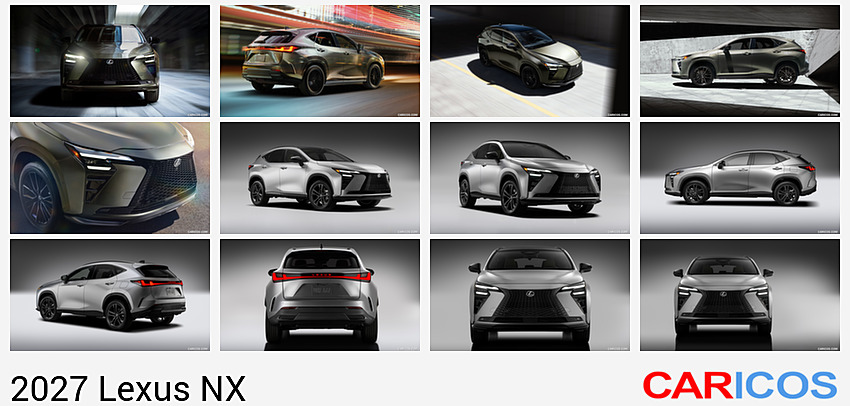
2027 Lexus NX Makes Hybrids the Rule
The 2027 Lexus NX drops its gas-only powertrain choices, leaving conventional hybrids and plug-in hybrids to carry the compact luxury SUV lineup. That does not make the NX an electric vehicle, but it does make electrification standard rather than optional. Lexus also adds DC fast charging to the plug-in model, expands its driver-assistance package, and revises everything from the steering rack to the battery packaging. The familiar body shape understates how much mechanical work sits underneath.
Two Powertrains Across Four Trims
Lexus plans to offer both the NX 350h hybrid and NX 450h+ plug-in hybrid in Premium, Premium+, F SPORT, and Luxury trims. Buyers choosing an NX 350h Premium or Premium+ can select front-wheel drive or all-wheel drive. The hybrid F SPORT and Luxury versions come only with AWD, as does every NX 450h+.
That arrangement gives the plug-in model the same four-trim spread as the conventional hybrid, rather than limiting its powertrain to a narrow slice of the lineup. Lexus has not announced 2027 NX pricing, horsepower, torque, 0-to-60-mph acceleration, or top speed. It also has not provided final EPA fuel-economy or electric-range ratings. Global market availability should begin by the end of 2026, though that does not establish a specific U.S. dealership arrival date.

The NX 450h+ Gets a Larger Battery and DC Charging
The 2027 Lexus NX 450h+ receives a new lithium-ion battery with 30% more capacity and 8% greater output than its predecessor. Those percentages describe the battery, not a corresponding increase in total vehicle horsepower. Lexus estimates more than 40 miles of electric driving on certain trims, with official EPA figures due nearer the sales launch.
Every plug-in NX now includes DC fast-charging capability and a powered charging-port door. The charging addition deserves attention, since it gives owners another way to replenish the battery beyond AC charging. However, Lexus has not disclosed peak charging power, charging times, or the pack’s capacity in kilowatt-hours. A DC connection alone does not explain how long a stop will take.
Battery packaging changes matter beyond range. Lexus turns the cell arrangement from lengthwise to crosswise and mounts the pack lower in the vehicle. The company attributes greater lateral body stiffness and a lower center of gravity to those revisions.
Both powertrain families benefit from an integrated e-Axle that combines the transaxle, electric motor, and power-control unit. This smaller, lighter assembly helps bring major components closer to the ground. Revised electronics and silicon-carbide semiconductors in the inverter target lower electrical losses.
Lexus also changes how the hybrid system delivers acceleration. The control strategy draws more heavily on the battery as speed builds, aiming to reduce excessive engine revving and better align engine rpm with road speed. A revised engine-block casting strengthens the engine-to-transaxle connection and shifts structural resonance away from combustion frequencies to reduce noise and vibration. Updated control software coordinates the engine and motor during the transition out of electric driving.
On AWD models, revised rear-motor management allows the E-Four system to maintain four-wheel propulsion during straight-line travel, not just when launching, cornering, or responding to wheel slip. Lexus targets more consistent stability and tire contact, including on slippery surfaces such as snow.
Small Control Changes, Extensive Chassis Work
Lexus reinforces both ends of the NX unibody, adds a floor crossmember, strengthens the center tunnel area, and redesigns the suspension towers with integrated structural elements. The aim extends beyond handling: a stiffer mounting structure can help the suspension control wheel movement while limiting body vibration and road noise.
Versions without Adaptive Variable Suspension receive new dampers with valves that respond to very small, low-speed suspension movements. Here, low speed refers to damper movement rather than the vehicle crawling through traffic. Lexus intends these shocks to limit body motion over rolling pavement without sacrificing ride compliance. Engineers developed the chassis at Toyota Technical Center Shimoyama in Japan and continued tuning at Germany’s Nürburgring.
The steering wheel shrinks by 0.4 inch to a 14.2-inch diameter. Every trim also gains a variable-ratio steering rack, while revised electric-assist calibration complements the quicker steering hardware. Lexus expands the wheel’s telescoping adjustment range and uses driving-position data to revise the relationship between the seat and steering wheel.
Changes to the accelerator combine new response calibration with a pedal assembly that produces less friction through its travel. The intent is finer speed control, rather than simply making the first part of the pedal feel more aggressive. A new brake-control strategy applies small braking inputs during cornering to manage yaw and roll, including during an abrupt lane change.
Even the airflow work has a chassis connection. Stiffer side-grille ducts help stabilize air moving around the tires, while fins inside the wheel housings guide air outward and reduce pressure buildup. Lexus links those changes to steadier straight-line behavior and a more settled feel at the contact patches.
A Familiar Shape With Less Chrome
The 2027 NX remains recognizable from the side, with pronounced rear shoulders, a rising lower window line, and a roof that tapers toward the spoiler. Lexus has not traded that angular profile for a softer crossover shape. Instead, it concentrates the visual changes at the ends and in the trim details.
Up front, the large mesh grille still dominates. The headlamps and cornering lights now sit within a more coordinated arrangement around it, while two narrow lighting lines combine the daytime running lights and turn signals. The broad hood and sharply drawn outer edges give the nose a planted appearance. It is a cleaner composition, although nobody will mistake the grille for a restrained design gesture.
Black finishes replace much of the chrome around the mirrors and exterior moldings. That choice reduces the number of competing bright accents and ties the window area more closely to the lower-body trim. The mesh grille also serves cooling and aerodynamic functions, rather than acting solely as decoration.
At the rear, paired L-shaped illuminated elements establish Lexus’ first Double L lighting signature. Illuminated Lexus branding accompanies them, emphasizing the tailgate’s width. The stronger light pattern supplies a clear visual update without requiring a different basic silhouette.
Lexus offers nine exterior colors. New additions include the ash-toned Shaded Ivy and Incognito, with the latter joining the F SPORT palette.
The NX F SPORT gets its own front lower spoilers, side pontoons, and rear-corner aerodynamic pieces. Gloss-black finishes cover the roof rails, roof spoiler, and rocker panels. Lightweight, high-rigidity 20-inch aluminum wheels and red brake calipers complete the exterior treatment. Inside, F SPORT pairs an all-black instrument panel with contrasting stitching.

A Bigger Standard Screen Without a Wall of Glass
Every 2027 Lexus NX includes a 14-inch Lexus Interface touchscreen, alongside a 12.3-inch digital instrument display. Lexus arranges the two displays along a horizontal dashboard theme, but keeps the instrument cluster and center screen visually distinct. The warm upholstery, slim vents, and broad dashboard surfaces give the cabin some relief from the electronics. I prefer that separation to treating the entire dashboard as one continuous display.
The redesigned steering wheel incorporates Lexus’ Responsive Hidden Switches, which use translucent control surfaces. A continuous lighting strip runs from the dashboard into the door trim, supplementing the ambient illumination and making the cabin appear wider. That is a visual effect, not a claim of additional passenger room.
Models with the optional Mark Levinson audio system receive perforated metal speaker covers. Illuminated rings around the door speakers shine through those grilles, adding another lighting element without placing a separate fixture on the door panel.
There's five interior color choices, including two new selections. Abalos draws its inspiration from the dunes of Mars’ northern hemisphere, while the more vivid Radiant Red belongs exclusively to F SPORT models.
The updated multimedia system brings quicker operation, additional personalization, and split-screen capability. It groups navigation, audio, vehicle information, and connected services within the central display. A standard Drive Recorder uses the exterior cameras to capture and save manually requested or automatically triggered video clips, providing dashcam functionality without adding a separate camera to the windshield.
Lighting, Music, and a Choice of Fragrance
Luxury and F SPORT buyers can add Sensory Concierge, which coordinates cabin lighting, music, airflow, climate settings, seat temperature, and fragrance. It is a less essential addition than the charging hardware or chassis changes, but Lexus gives it considerable scope for personalization.
The three presets take different approaches. Inspire combines more stimulating audio and illumination with refreshing airflow and corresponding comfort settings. Radiance aims for a balanced environment that supports attention during everyday travel. Revitalize uses quieter ambient sounds, softer lighting, and comfort-oriented adjustments to encourage relaxation.
Owners can also choose fragrances independently of those presets. Shinmei uses citrus notes and takes dawn as its reference point; Seiyo combines white-floral notes with a springtime theme; Hanya uses musk for a nighttime-inspired atmosphere. The system can accompany each scent with its own coordinated visuals, music, and illumination.
Standard Safety Systems With Specific Operating Limits
Lexus Safety System+ 4.0 comes standard throughout the 2027 NX lineup. Lexus expands sensor coverage and detection capability, adds broader assistance functions, and provides clearer representations of surrounding traffic in the instrument display. These remain driver-support systems, not a substitute for an attentive driver.
The Pre-Collision System uses a camera and millimeter-wave radar to detect vehicles, pedestrians, bicyclists, and motorcyclists under supported conditions. It provides audible and visual warnings and can apply automatic emergency braking if the driver does not respond.
Risk Avoidance Emergency Steer Assist supplements a driver-initiated evasive maneuver with steering torque to help stabilize the vehicle and limit unintended lane departure. Its stated operating conditions require the collision system to be on, no turn-signal operation, vehicle speed between 25 and 50 mph, and a relative speed to the detected object within that same range.
Intersection Turn Assist monitors certain crossing-traffic situations involving vehicles, motorcycles, bicycles, and pedestrians. It can warn and brake during supported left turns across an oncoming vehicle’s path or right turns involving a detected pedestrian.
Full-Speed Range Dynamic Radar Cruise Control manages following distance across its operating speed range. With that cruise function active and appropriate lane information available, Lane Tracing Assist uses road markings and/or a preceding vehicle to help keep the NX centered. Separately, Lane Departure Alert with Steering Assist operates above 30 mph when it recognizes lane markings or suitable road-edge boundaries. It warns of an unintended departure and can provide a small corrective steering input if the driver does not act.
Road Sign Assist recognizes speed limits, stop signs, and certain warning signs, then displays corresponding icons in the instrument panel. Automatic High Beams switch between high and low settings according to surrounding conditions. Proactive Driving Assist uses camera and radar information to make gentle braking or steering adjustments during supported tasks, including maintaining separation from traffic ahead.
Available Traffic Jam Assist addresses congested, low-speed travel on limited-access roads. It can maintain a following gap, stop and resume with traffic, and temporarily provide hands-free steering assistance. The driver must remain alert and ready to take over immediately. The feature requires Drive Connect service and 5G connectivity; Lexus includes a three-month trial.
Other available assistance includes Lane Change Assist, an extension of Lane Tracing Assist that uses camera and radar information to execute a lane change under appropriate conditions. Rear Pedestrian Detection can warn and brake for someone behind the vehicle. Front Cross-Traffic Alert warns of approaching crossing vehicles during low-speed intersection entry, using an audible alert and, where equipped, the head-up display.

The Connected Features Have Different Trial Periods
The available Digital Key lets compatible devices unlock, start, and operate the NX, with access sharing through supported digital wallets. It requires an active Remote Connect trial or subscription. Lexus includes five years of Remote Connect for the 2027 model year, covering app-based remote starting, door locking and unlocking, vehicle-status checks, and related functions.
Safety Connect also carries a five-year trial. Its in-vehicle SOS button links occupants with a round-the-clock response center for urgent assistance. A separate five-year Service Connect trial provides vehicle-health information and alerts, plus maintenance scheduling with a preferred Lexus dealer through a connected device.
Wi-Fi Connect supports as many as five devices through the onboard 5G hotspot. Its included trial lasts 30 days and supplies unlimited hotspot data during that period. Depending on the mobile carrier, owners may have the option to add the service to an existing cellular plan.
Drive Connect has the shorter three-month trial and covers several functions. The enhanced Intelligent Assistant responds to the Hey Lexus prompt for requests involving temperature, navigation, audio, and other supported controls. Destination Assist provides access to a live agent 24 hours a day and can send a selected destination to Cloud Navigation. The cloud-based navigation service uses current data for routing and turn-by-turn directions.
These connected services depend on 5G network availability, compatible equipment where applicable, and an active trial or subscription. Buyers should distinguish the standard 14-inch screen from the connected functions whose included service periods eventually expire.
The Substance Sits Below the Styling
The 2027 Lexus NX takes its biggest steps through broader hybrid availability, revised battery hardware, DC charging, and extensive changes to the structure and controls. The styling evolves rather than starts over, and the standard larger touchscreen provides a straightforward equipment upgrade. Fragrance presets add another layer of cabin customization, but the more consequential changes address how the NX stores energy, delivers power, and manages body movement. Pricing and final specifications remain missing pieces, especially for shoppers comparing the NX 350h with the plug-in NX 450h+.
-Ed
 2027 Lexus NX