2026 Ferrari 849 Testarossa Spider pairs 1,036 hp with a 14‑second roof
The 2026 Ferrari 849 Testarossa Spider steps into the slot previously held by the SF90 Spider and brings back a storied badge with thoroughly modern hardware. It’s a plug‑in hybrid with three e‑motors working alongside a comprehensively reworked 3.9‑liter twin‑turbo V8. Total output is rated at 1,050 cv, which translates to about 1,036 hp. Beyond the headline numbers, Ferrari has rethought the aero, the cockpit, and the control electronics to make its new open‑top flagship quicker, calmer with the roof down, and more consistent when driven hard.
Powertrain and performance
At the center of the 2026 Ferrari 849 Testarossa Spider is the latest evolution of the F154 V8. Displacement holds at 3,990 cc, but the hard parts are substantially new: cylinder heads, block machining, valve gear, fuel rails, exhaust manifolds, intake plenums, and titanium fasteners. The big news is a larger turbocharger—the largest fitted to a Ferrari road car—spinning on low‑friction bearings. The V8 now makes 830 cv (about 818 hp) and 842 Nm (621 lb‑ft) at 6,500 rpm, revving to an 8,300‑rpm limit.
Three electric motors add 220 cv to the mix: two up front for on‑demand all‑wheel drive and torque vectoring, and one MGU‑K on the rear axle derived from Ferrari’s F1 program. A 7.45‑kWh lithium‑ion pack sits low in the structure, enabling up to 25 km (about 16 miles) of EV range in eDrive mode. Drivers toggle eDrive, Hybrid, Performance, or Qualify via the e‑Manettino to choose how aggressively the system deploys the battery and motors.
Ferrari quotes 0–100 km/h in under 2.3 seconds, which puts 0–60 mph in the low‑two‑second bracket, and 0–200 km/h (124 mph) in 6.5 seconds. Top speed is north of 330 km/h (205+ mph). The Spider’s Fiorano lap is listed at 1:18.100. Dry weight is 1,660 kg (about 3,659 lb) with a 45/55 front‑to‑rear balance, yielding a 1.58 kg/cv power‑to‑weight figure. An 8‑speed dual‑clutch gearbox handles shifting duties.

Control electronics and chassis tuning
The 849 Testarossa Spider layers new software on top of substantial hardware. ABS Evo and the Ferrari Integrated Vehicle Estimator (FIVE) headline the driver‑assistance side of performance. FIVE runs a real‑time “digital twin” of the car, estimating speed to within 1 km/h and yaw angle within 1 degree, then feeds that to the traction control, e‑diff, and front e‑axle to clean up responses. ABS Evo uses those estimates to target individual wheel slip and sharpen braking distribution in every Manettino position. The brake‑by‑wire system blends stronger regeneration with hydraulics more progressively than before, aiming for a pedal that feels natural rather than simulated.
Springs and dampers are retuned, with road springs 35% lighter, a 10% reduction in roll gradient, and fresh kinematics for better rear‑axle bite at the limit. Bigger discs, revised ventilation paths, and stiffer rear calipers address thermal capacity. Despite the added performance kit, weight matches the outgoing SF90 Spider—a notable save that keeps the numbers honest.
Aerodynamics that work the whole car
Downforce at 250 km/h is said to reach 415 kg (about 915 lb), up 25 kg versus the SF90 Spider, while cooling capacity improves by 15%. The front underfloor—responsible for 35% of the total load—uses three pairs of cascading vortex generators and redesigned channels to boost outwash and airflow management. A squarer front bumper integrates small vertical elements that help pull air out of the wheel wells while feeding the larger intakes.
Along the sides, the doors double as ducts that feed the intercoolers and rear brakes, with additional inlets molded into the trim. At the back, the Spider adopts a twin‑tail theme that works with an active rear element. That spoiler snaps between low‑drag and high‑downforce modes in under a second and can contribute up to 100 kg (220 lb) of the rear load at 250 km/h. A multi‑level rear diffuser and big vortex generators complete the ground‑effect package, trimming drag compared with the SF90 Spider’s underbody.
For top‑down use, Ferrari built a “wind catcher” into the rear bench to pull high‑energy airflow off the top of the cabin and release it low in the footwell area, cutting turbulence without blunt screens. Another detail—the bridge‑like tonneau cover behind the seats—channels air toward the engine lid and spoiler so that, with the roof closed, the Spider’s downforce aligns with the coupe’s.
Roof, sound, and the way it feels
The retractable hardtop opens or closes in 14 seconds at speeds up to 45 km/h (28 mph). As ever, the test for any hybrid supercar is coherence. Ferrari’s calibration team chased smoother transitions between electric and gasoline power with an active damping function that steadies the V8’s idle and refines handoffs. Electric‑motor cooling maps were tightened to keep temps roughly 10–12°C lower, which should help maintain e‑performance on track days.
Exhaust components switch to larger‑diameter Inconel manifolds and a lighter flexible joint, while the soundtrack aims for richer midrange timbre and brighter upper harmonics as the flat‑plane crank swings past 8,000 rpm. Shift programming, borrowed from the SF90 XX Stradale and re‑tuned here, accentuates upshifts when you’ve rotated the Manettino into its sportier settings.

Design notes
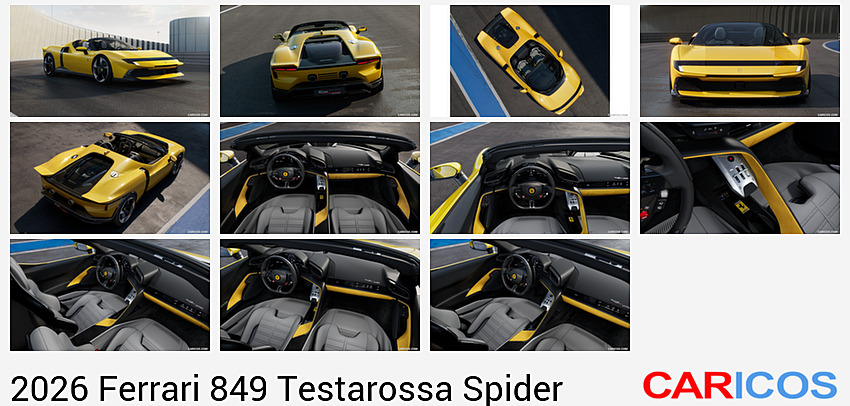
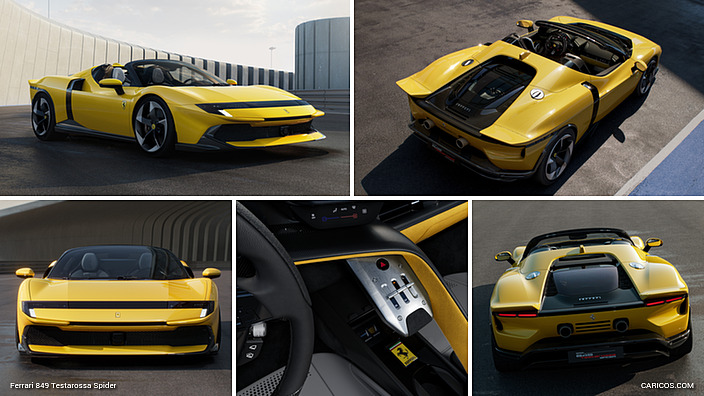
Ferrari leaned into prototype‑era cues while keeping the proportions firmly mid‑engine. The stance is low and cab‑forward, but it’s the surfacing that jumps out: a deeply sculpted door that doubles as an aero conduit, vertical intakes that are more architectural than ornamental, and a sharp front fascia traversed by a full‑width element that links the headlamps. The rear is all muscle—two distinct tail volumes framing round exhausts, with the active wing integrated cleanly. The forged wheels wear aero‑profiled spokes to help extract air from the wells.
Inside, the dashboard stretches horizontally, then pinches toward the driver with a “sail” that carries the metal shift gate and primary controls. Ferrari returns to physical buttons on the steering wheel—small victory for tactility—while the digital cluster handles hybrid modes and telemetry. Space usage improves with slimmer lower door sections and a reworked tunnel. Seats come in two forms: a comfort shell or a carbon‑fiber race seat with more lateral support.
Infotainment, connectivity, and ADAS
Apple CarPlay and Android Auto are onboard, as is wireless phone charging in the center tunnel and the MyFerrari Connect app for remote vehicle services. Driver‑assistance tech is present but meant to stay out of the way: Adaptive Cruise Control with Stop & Go, Automatic Emergency Braking with cyclist detection, Blind‑Spot Detection, Lane Departure Warning and Lane Keeping Assist, Automatic High Beams, Traffic Sign Recognition, Surround View monitoring, Rear Cross‑Traffic Alert, and driver fatigue monitoring.
Wheels and tires
Ferrari co‑developed rubber specifically for the 2026 849 Testarossa Spider with Michelin, Pirelli, and Bridgestone. Choices range from street‑focused Bridgestone Potenza Sport (including a run‑flat version) and Pirelli P Zero R to serious track options like Michelin Pilot Sport Cup 2 and Cup 2 R. Sizes are 265/35R20 up front on 9.5‑inch rims and 325/30R20 at the rear on 11.5‑inch rims.

Assetto Fiorano package
For buyers who want more edge, the Assetto Fiorano spec trims about 30 kg (66 lb) by way of composite pieces, a lightweight tubular seat (-18 kg), and optional 20‑inch carbon‑fiber wheels. Fixed‑rate Multimatic dampers, lighter springs, and revised aero parts change the car’s balance: the front underfloor adds extra vortex generators, and the rear twin‑tail is replaced by twin wings with high‑incidence profiles and endplates. Ferrari says the set‑up can triple rear downforce versus the standard twin tails with only a modest drag penalty. Michelin Pilot Sport Cup 2 tires are available specifically for this configuration, and for the first time you can pair Assetto Fiorano with a front‑axle lifter by keeping the Magneride dampers.
Compared with the 849 Testarossa coupe
We have a separate deep dive on the fixed‑roof 849 Testarossa, but a quick snapshot is useful. Both body styles share the same 1,050‑cv output and major hardware. The coupe claims a slightly quicker 0–200 km/h run (6.35 s) and a 1:17.500 Fiorano lap. It also lists a lower dry weight at 1,570 kg (about 3,461 lb) and a taller overall height (1,225 mm vs. the Spider’s 1,186 mm). With the Spider’s roof closed, that clever rear bridge keeps downforce aligned with the coupe, which is not common for convertibles in this class.
Thermal management and braking specifics
To support the extra 50 cv from the V8, Ferrari enlarged the coolant radiators and reshaped their geometry for an 18% increase in surface area. The intercoolers grow by 19% and sit at a reduced angle to fit the chassis packaging. Front air intakes are 18% larger, with separated internal ducts for the brakes and radiators. At the rear, integrated slots and vents use the wake’s low pressure to draw hot air from the engine bay and electronics. Brake cooling is beefed up as well: the front sees a 15% higher flow to the calipers, and the rear intake—now carved into the flank—bumps flow by 70%.

Sustainability touches
Ferrari is using recycled secondary aluminum for key engine castings (heads, crankcase, and sump). The supplier process can cut CO₂ emissions per kilogram of aluminum used by up to 80%, amounting to roughly 0.4 metric ton of CO₂‑equivalent saved per car. It’s a thoughtful change, even if the centerpiece remains a high‑output V8.
Practical bits
The retractable roof works at up to 28 mph, there’s 74 liters (about 2.6 cu‑ft) of luggage space, and the fuel tank holds 68 liters (18.0 gallons). Weight distribution sits at 45% front and 55% rear. Claimed braking from 100 km/h to zero is 28.5 meters (about 94 feet). Official U.S. fuel‑economy figures and EPA CO₂ ratings are pending.
Maintenance and warranty programs
Like other modern Ferraris, the 2026 849 Testarossa Spider comes with a seven‑year scheduled‑maintenance plan. Hybrid components carry a five‑year warranty. Owners who purchase the Warranty Extension Hybrid program can stretch coverage to year eight, at which point Ferrari replaces the high‑voltage battery at no additional cost. The Power Hybrid program extends major powertrain coverage from years 8 through 16 and again includes HV battery replacement at year 16.

Pricing and availability
U.S. pricing for the 2026 Ferrari 849 Testarossa Spider hasn’t been released. Given that it replaces the SF90 Spider and raises performance across the board, expect a figure above that car’s territory. Production volumes and first U.S. deliveries are TBA.
Design with a purpose, and plenty of numbers to match
Ferrari didn’t just chase a bigger power figure for the 849 Testarossa Spider; it worked the airflow, the software, and the hybrid calibration to make the open car behave like the closed one while adding more speed. The complexity is high—three motors, brake‑by‑wire, a digital twin predicting your next move—but the payoffs are measurable: 1,036 hp, sub‑2.3‑second 0–62 mph, and real aerodynamic load. If you prefer a roof, the 849 Testarossa coupe does the purist thing a tick quicker. If you want the sky and the numbers, this Spider aims to give you both without compromise.
-Ed
 2026 Ferrari 849 Testarossa Spider