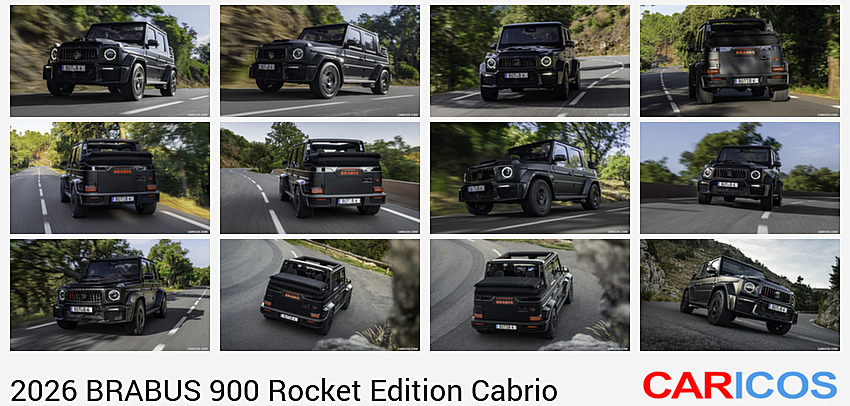
2026 Brabus 900 Rocket Edition Cabrio Keeps All Four Doors
The 2026 Brabus 900 Rocket Edition Cabrio turns the Mercedes-AMG G 63 into something the factory does not currently offer: a four-door convertible with a power-operated fabric roof. Brabus pairs that conversion with an enlarged twin-turbo V8, substantial chassis changes, and a thoroughly retrimmed cabin. The company has chosen the 2026 Monaco Yacht Show for its world debut and will build just 10 examples, each configured to its buyer’s preferences.
This is the first convertible in the Brabus Rocket family, although the company’s roof-cutting work started earlier. Beneath the lighting, carbon fiber, and oversized wheels sits a fairly involved engineering project. That part deserves at least as much attention as the number on the badge.
A Convertible Conversion With Its Own Structure
The Rocket builds on the cabriolet conversion Brabus developed in 2025 for the current W465-generation Mercedes-AMG G 63. It joins a coachbuilding lineup that includes the Brabus BODO coupe and convertible, the Rocket GTS Hyper Gran Turismo shooting brake, and the four- and six-wheel XL and XLP pickups.
Brabus used computer-aided design and structural simulations to rework the G-Class body, targeting the same rigidity as the closed-roof vehicle. The company says it achieved that target and completed Germany’s TÜV testing and approval process. Its two-section roof assembly incorporates more than 500 newly developed parts built to what Brabus describes as original-equipment quality standards.
The electric soft top takes 20 seconds to open or close and includes a heated safety-glass rear window. At the front, it latches to a strengthened windshield surround. A broad carbon-fiber bow helps the fabric hold its shape at speed and limits cabin noise, while frames above the doors provide additional support. Behind the rear doors, a steel roll bar called the C-BOW anchors the rear roof section and wears exposed-carbon exterior trim.
Opening the roof gathers the rear section behind the back seats, where a fitted tonneau cover keeps debris off the folded fabric. Brabus also gives the roof some branding of its own: two dark contrasting stripes, company lettering, and an inverted woven 77 emblem above the rear window that references its 1977 founding. Weather sealing, sound insulation, and durability formed part of the development work. Every completed Cabrio must pass more than 10 hours of continuous water testing in a climate chamber before delivery.

A Larger V8 With a Torque Ceiling
The 900 Rocket Edition Cabrio uses more than a software tune to reach its advertised output. Brabus enlarges the four-valve, twin-turbo V8 from 3,982 to 4,407 cc. Although the company markets this as a 4.5-liter engine, the actual displacement is closer to 4.4 liters. The work includes 84-millimeter cylinder bores, forged pistons, upgraded connecting rods, and a balanced crankshaft machined from billet that extends the stroke to 100 millimeters.
Under a red carbon-fiber engine cover, two replacement turbochargers use larger compressor assemblies and strengthened axial bearings. Maximum boost reaches 1.4 bar, approximately 20.3 psi. Two BoostXtra valves add an audible release during load changes. Brabus also develops separate injection, ignition, and boost-control calibrations, using dynamometer work and road testing to match the mechanical and electronic changes. It recommends Motul lubricants throughout the powertrain.
Peak output arrives at 6,200 rpm. The stated 662-kW figure converts to approximately 888 horsepower in U.S. units, or 900 metric horsepower, explaining the model name. That represents an increase of about 310 U.S. hp over the standard G 63 engine. The V8 can generate 922 lb-ft at 2,900 rpm, but an electronic limit holds torque to 774 lb-ft in the vehicle. That distinction matters more than the larger headline number.
Brabus claims a 3.7-second run from 0 to 62 mph for the 2026 Rocket Cabrio. It does not provide a separate 0-to-60-mph result. An electronic governor caps maximum speed at 149 mph to protect the tires, rather than letting the engine’s output determine the upper limit.
Four Exhaust Tips and Two Sound Settings
A stainless-steel exhaust system supports the engine changes with 3.0-inch downpipes, dedicated particulate filters, and metallic catalytic converters. Electronically controlled valves let the driver select a louder Sport setting or the quieter Coming Home mode from the cabin. The latter seems particularly useful in a vehicle that can remove much of the barrier between its occupants and its exhaust.
Two outlets sit ahead of each rear wheel. Carbon-fiber surrounds frame them, and Brabus adds its Rocket Launch Ambience Light around the tips. The lighting makes an already conspicuous exhaust arrangement harder to overlook, although the selectable sound control offers a welcome measure of restraint.
The G-Class Shape Survives the Styling Work
There's two competing ideas in the exterior design. The upright windshield, flat body panels, exposed hinges, and squared-off doors preserve the G-Class’s utilitarian outline. Around that familiar shape, Brabus layers deep bumpers, broad wheel arches, and large areas of carbon fiber. The matte-and-gloss black paint combination keeps the color palette relatively quiet, even if the bodywork is not.
The front bumper incorporates large cooling openings and a lower spoiler. Above it, an illuminated carbon-fiber grille surround frames two red accent stripes and a lit Brabus emblem. The raised Powerdome hood treatment adds another visual layer to an already tall nose. Gloss-finished exposed carbon continues around the widened fenders, behind both the front and rear arch extensions, and over the mirror caps. LEDs illuminate the running boards for entry.
From the side, retaining the door frames and roll bar makes this look more like an opened-up G-Class than a conventional convertible. That is arguably the right approach for such a recognizable shape, though the folded roof creates a substantial stack over the rear body. At the back, a carbon-fiber tailgate panel carries red-illuminated Brabus lettering, while the replacement bumper meets the wider rear fenders. The result feels deliberately muscular rather than visually light.

Three-Spoke Wheels Set the Chassis Agenda
The 24-inch Platinum Edition forged wheels reinterpret the Brabus Monoblock II three-spoke design from the late 1980s. Their broad spokes provide a more distinctive detail than another densely patterned wheel would, and the exposed-carbon aeroblades add a second layer around them. Brabus says those blades help direct airflow and reduce turbulence around the rotating wheels.
Front wheels measure 10 inches wide and carry 295/30 ZR24 tires. The rear wheels stretch to 12 inches, with 345/25 ZR24 rubber. These are performance road tires, not an attempt to preserve the standard G-Class’s trail-oriented versatility. Whatever the donor vehicle’s background, this specification clearly favors pavement.
Brabus worked with KW on the RideControl aluminum coilover suspension, tuning it specifically for that wheel-and-tire package. The front struts and rear dampers use machined-from-solid construction, and the rear units incorporate cooling elements. Owners can lower the body by as much as 1.8 inches, or 45 millimeters, and adjust damping through the factory Drive Select control. The available adjustment is useful, although it does not change how little tire sidewall those 24-inch wheels leave.
Black Leather With Red Almost Everywhere
Inside the 2026 Brabus 900 Rocket Edition Cabrio, the company’s in-house upholstery shop combines black leather with Alcantara. Its Shell quilting extends beyond the seats and door panels to the leather-lined footwells, cargo area, and leather floor mats. Perforated seat centers preserve the seat-climate functions. Red stitching and piping outline the otherwise dark surfaces.
The red treatment goes well beyond thread. Brabus finishes switches, speaker grilles, air vents, trim pieces, handles, and door-lock pins in its Rocket Red color. Against the black dashboard and upholstery, those small components become unusually prominent. The basic G-Class cabin layout remains recognizable, but the repeated red outlines make it considerably busier.
Gloss-coated carbon trim covers additional cabin surfaces, and the pedal pads use carbon fiber as well. Stainless-steel sill plates carry illuminated Brabus logos that can follow the selected ambient-lighting color. More practically, Easy Entry hinges allow the rear doors to open to 90 degrees, improving access to the back seats.
Carbon-fiber shift paddles contain LED engine-speed indicators that progress from green through yellow to red as revs rise. The speedometer scale reaches 300 km/h, approximately 186 mph, despite the vehicle’s 149-mph governor. Each example also comes with leather-trimmed keys and a Brabus Weekender bag coordinated with its individual interior specification.
An Export Price and a Digital Paper Trail
Brabus lists the specified example at €890,740 as an export price excluding German VAT. That is not a U.S. MSRP, and the company has not supplied dollar pricing or U.S.-specific certification details. With only 10 cars planned and individual commissions determining their configurations, that figure describes this particular specification rather than a universal delivered price.
A dedicated specification plate in the luggage compartment incorporates a blockchain-based Digital Product Passport. Brabus developed the system with the Aura Blockchain Consortium to document authenticity, ownership, and vehicle specifications. For a low-volume, individually configured vehicle, a verifiable build record has a clear purpose, even if the blockchain component is less tangible than the metal plate carrying access to it.
The published European WLTP combined fuel-consumption figure is 16.3 liters per 100 kilometers, equivalent to 14.4 mpg in U.S. gallons. That is not an EPA rating. Combined carbon-dioxide emissions reach 370.6 grams per kilometer, and Brabus lists compliance with Euro 6E-ISC-FCM emissions requirements alongside a European efficiency classification of G.

The Roof Is the Real Difference
High output and elaborate trim are familiar territory for Brabus. The more meaningful distinction here is a four-door G 63 convertible with a purpose-built roof, structural revisions, and an extensive sealing-validation process. The 2026 Brabus 900 Rocket Edition Cabrio combines that work with styling that leaves little doubt about its maker. Not every illuminated detail feels necessary, but the conversion itself gives this limited-run model a clearer identity than power and carbon fiber alone could provide.