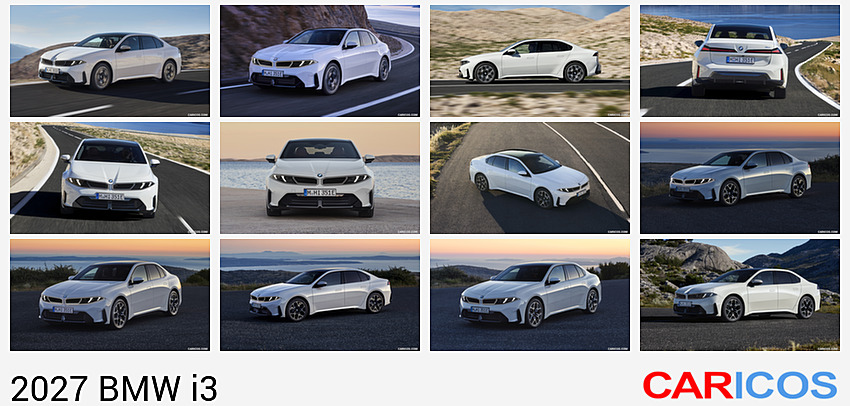
2027 BMW i3 Takes the 3 Series Electric
BMW’s new electric sedan wears an i3 badge, but its place in the lineup is straightforward: this is the battery-powered member of the eighth-generation 3 Series family. The 2027 BMW i3 shares its visual direction and much of its cabin technology with the gasoline sedans, while using a dedicated Neue Klasse platform, an 800-volt electrical system, and different driving-control hardware. Its headline numbers include 463 horsepower and as much as 468 miles of estimated range. The more interesting changes extend beneath the bodywork, where BMW integrates the battery into the structure and gives fewer computers more responsibility.
A $62,850 Starting Point With Destination
The 2027 BMW i3 50 xDrive starts at $61,500. Add the mandatory $1,350 destination charge, and the entry price becomes $62,850 before options and taxes. BMW schedules the U.S. launch for the first quarter of 2027, alongside the gasoline-powered BMW 330, 330 xDrive, and M350 xDrive.
Two motors provide all-wheel drive, with combined ratings of 463 horsepower and 476 pound-feet of torque. BMW lists a 4.5-second run from 0 to 60 mph. Preliminary company testing using EPA procedures puts range between 446 and 468 miles, depending on configuration. Those figures are not finalized EPA ratings.
BMW has not supplied the i3’s top speed, usable battery capacity, curb weight, or a 10-to-80-percent charging time. A more powerful BMW i3 M60 xDrive will follow during 2027, but its output, acceleration, range, and price remain unspecified.

A Sedan Shape Without the Tall Grille
The i3 measures 187.4 inches long, 73.4 inches wide, and 58.3 inches tall, with a 114.1-inch wheelbase. Compared with the accompanying gasoline 3 Series, it has 1.5 inches more between the axles and stands an inch taller. Similar styling therefore does not mean identical proportions. BMW also widens the tracks relative to the preceding generation.
The long wheelbase and abbreviated overhangs give the electric sedan a fairly settled stance. BMW describes the body as a 2.5-box design, with a softer transition between the passenger compartment and trunk than a sharply separated three-box sedan. The cabin sits rearward, a low side crease keeps the doors from looking overly tall, and the rear fenders carry noticeable volume. Concealed window seals and flush handles, which extend as someone approaches, remove some of the usual visual clutter.
To my eye, the front is the most successful part of the redesign. BMW stretches the kidney shapes sideways and incorporates the headlights and sensors into the same broad graphic, rather than making grille height the main event. Paired upright daytime-running-light elements preserve the familiar four-light arrangement and double as turn signals. A forward-leaning nose and the roundel’s recessed position above the kidneys add definition without requiring many separate trim pieces.
The rear follows the same horizontal approach. Thin lamps reach into the shoulders, with two elements on each side giving BMW’s L-shaped pattern a three-dimensional treatment. The badge sits in the depression between them. The broad black lower bumper looks heavier than the comparatively spare upper body, although the absence of exhaust outlets keeps the composition simpler than on the M350.
Wheels, Paint, and Optional Lighting Ceremony
BMW supplies 19-inch alloy wheels as standard. The selection of wheels include eight alloy and aerodynamic designs, spanning 19 to 21 inches. Eleven exterior colors will be available at launch, including Le Castellet Blue metallic, along with solid, metallic, and matte-look Frozen finishes. Additional BMW Individual paints arrive during 2027.
Optional Iconic Glow lighting outlines the kidneys and adds three selectable animation themes: Balanced, Relaxed, and Excited. The exterior welcome sequence continues inside the cabin, with departure lighting also varying by equipment. It is a more theatrical treatment than the basic body design needs, but BMW leaves it optional on the i3 50 xDrive.
The M Sport package brings model-specific bumpers, side skirts, and a rear diffuser through the M Aerodynamics package. Buyers can add M Sport brakes with blue calipers. M Sport Professional instead includes black mirror caps, a black rear spoiler, and M Sport brakes with red calipers. Both packages also provide access to chassis and steering-wheel upgrades, so their differences go beyond exterior trim.
The Battery Becomes Part of the Body
The 2027 i3 uses BMW’s sixth-generation electric-drive technology, following the BMW iX3 as the second Neue Klasse model. Across the Gen6 program, BMW cites approximately 30 percent greater range and 30 percent faster charging than its previous-generation technology, with larger range gains in some applications.
New cylindrical lithium-ion cells measure 46 millimeters in diameter and 95 millimeters tall. BMW reports a 20 percent increase in volumetric energy density over its preceding prismatic cells. The company installs these cells directly into the battery pack rather than grouping them into separate modules, reducing intervening material, weight, and cost while allowing a flatter package.
The battery housing also helps form the vehicle structure. BMW builds the body with an open floor, then closes that opening by installing the battery. Its housing cover takes over the conventional underbody’s role. This arrangement removes duplicate structure and increases torsional stiffness, while the shallow pack supports the sedan’s low stance and center of gravity.
BMW places its Energy Master controller above the battery beneath the rear seat. Developed internally, the unit distributes power to the motors and other electrical systems, manages the battery’s data connections, and supervises high-voltage operation. It also contains the switching hardware that lets the 800-volt car use 400-volt DC charging equipment.

Two Motors With Different Jobs
The rear axle serves as the primary drive axle. Its electrically excited synchronous motor produces up to 322 horsepower and 321 pound-feet. Instead of relying on permanent magnets in the rotor, it uses electrically energized electromagnets. BMW can reduce the magnetic field during light-load operation to limit losses, then increase it when the driver requests more torque.
An inverter converts the battery’s direct current into the three-phase alternating current the motor needs, while also regulating rotor excitation. At the front, an asynchronous motor supplies up to 165 horsepower and 188 pound-feet. Its rotor uses aluminum conductors joined by short-circuit rings; the difference between rotor and stator-field speeds induces the current that produces torque.
The individual motor ratings do not add directly to the advertised system output, because their maximum outputs need not occur together. BMW rates the complete i3 50 xDrive at 463 horsepower, not the 487-horsepower sum of the two component figures. Compared with Gen5 hardware, the company attributes 40 percent lower energy losses, 20 percent lower cost, and 10 percent less weight to the new motor combination.
Fast Charging and Power Going the Other Way
The BMW i3 50 xDrive accepts DC charging at up to 400 kW. BMW estimates that a 10-minute session can replenish enough energy for 191 to 208 miles, using its preliminary EPA-procedure range calculations. Battery temperature and the charging equipment must support that performance. The 400-kW figure describes peak capability, not a rate the car maintains throughout an entire session.
AC charging tops out at 15.4 kW. BMW’s Wallbox Plus can deliver that output at up to 64 amps, with an adjustable setting to suit the home’s electrical installation. It supports a NACS connector and offers Wi-Fi, Bluetooth, RFID, and vehicle MAC-address connectivity for setup, monitoring, and access control.
The portable Multifunction Charger works with ordinary 120-volt outlets through a NEMA 5-15 plug or 240-volt outlets through a NEMA 14-50 adapter. BMW offers additional lower-power adapters separately. The cable or charger fits in the storage compartment beneath the hood.
Bidirectional capability allows the i3 to supply electricity as well as receive it. An optional Vehicle-to-Load adapter lets the Multifunction Charger power several external devices with a combined output of up to 3.7 kW. Vehicle-to-Home equipment allows the battery to support a home during an outage. Those functions require the appropriate additional equipment; the car’s electrical capability alone does not constitute a complete home-backup installation.
Charging Stops Become Part of the Navigation
BMW Maps can plan charging stops when a destination lies beyond the battery’s remaining range. Drivers can set minimum arrival charge levels for both intermediate stops and the destination, and prioritize preferred operators. BMW highlights IONNA, whose network includes more than 180 sites and 1,500 high-power charging plugs.
The planner considers past charging-session data, expected power, reliability, and precise station location. It displays live availability, connector types, plug counts, expected charging duration, and projected costs using stored tariffs. Nearby restaurants, restrooms, stores, and play areas appear as well. The route synchronizes with the My BMW App, allowing passengers to review and adjust the plan.
Selecting a DC charger in navigation automatically starts battery heating or cooling as needed. Drivers can also request preparation through the center screen or app, where they can check the battery’s temperature status and remaining preparation time. A separate predeparture function conditions the battery for the journey, particularly in cold weather. BMW recommends running that process while plugged in because it consumes energy.
The charging port sits at the right rear. Its powered flap responds to a manual push or can open when the car recognizes an intention to charge, including a learned walking path toward a charging point. It closes automatically when unused and after charging-related activity. Plug & Charge handles authentication at compatible stations, including IONNA, through ISO 15118-2 communication. Owners can store as many as ten participating charging contracts instead of relying on a separate app or card for each session.

Software Takes a Larger Role in Handling
BMW’s Heart of Joy computer coordinates the i3’s drive system, braking, steering subfunctions, charging, and energy recovery. Working with the BMW Dynamic Performance Control software stack, it consolidates jobs that previously belonged to separate controllers. BMW says it processes these functions ten times faster than earlier systems, targeting more consistent responses and closer coordination between traction and deceleration.
That is the electric sedan’s technical implementation, not simply the control arrangement used by the gasoline 3 Series. BMW traces its electronic chassis-control experience back to the 1979 BMW 7 Series, which brought the brand’s first anti-lock braking system, but the i3 places substantially more responsibility in one unit.
The mechanical foundation includes a double-joint spring-strut front suspension, a new five-link rear suspension, lift-related dampers, and anti-roll bars with high-preload mounts at both ends. Optional Adaptive M Suspension, available for the i3 50 xDrive through M Sport or M Sport Professional, pairs adjustable damping with variable-ratio sport steering.
Soft Stop uses regenerative braking to reduce the final jolt as the car comes to rest. BMW intends the motors to handle nearly all ordinary deceleration, with friction brakes contributing during harder driving and emergency stops. Coordination with the automated-driving computer also allows assisted braking to use regeneration down to a standstill, except when emergency braking demands otherwise.
The M60 Adds More Than an Output Increase
The forthcoming BMW i3 M60 xDrive will combine two Gen6 M eDrive motors with M-specific control software. Steering-wheel paddles will let the driver alter the powertrain’s response rather than simply imitate a conventional transmission. BMW also plans speed-dependent sound and driving-feedback functions.
Its exterior receives a distinct front lighting graphic and optional yellow light elements inspired by GT racing cars and the BMW M Hybrid V8. A thinner, more linear rear-light pattern separates it from the 50 xDrive. Exclusive 21-inch Style 1067M aerodynamic wheels will be available.
As an M Performance model, the M60 also receives the M steering wheel and Harman Kardon audio. Optional M Sport seats can use Adelaide Grey upholstery within the BMW Individual treatment. BMW has identified these details ahead of the performance figures, leaving the launch model as the only i3 with a complete published U.S. specification so far.
A Light Cabin With Fewer Separate Instruments
The interior’s main visual change is the absence of a conventional instrument cluster behind the steering wheel. A low information band runs beneath the windshield, while the large center screen sits closer to the driver. Lines from the doors continue into the dashboard, and the standard panoramic glass roof uses climate-comfort glazing. The light upholstery makes the cabin look open rather than cocooned, though the center display remains a substantial object in that otherwise spare layout.
Standard front seats offer power adjustment, memory, and lateral support, with their adjustment switches mounted on the doors. BMW’s Travel & Comfort accessory system appears on the seatbacks for rear passengers. Optional multifunction seats add lumbar and backrest-width adjustment plus massage. That last feature distinguishes the electric i3’s multifunction seats from the ventilated arrangement BMW specifies for gasoline models.
Three interior themes organize the materials. Contemporary uses synthetic Veganza upholstery in Digital White, Castanea, Agave Green, or Black. BMW M combines Black Veganza with M PerformTex, while BMW Individual offers Black Merino leather. A white BMW Individual steering wheel is exclusive to the Digital White Contemporary cabin.
The standard wheel places a spoke above its center and includes substantial thumb rests. The alternative flattened M wheel positions its lower spokes at approximately four and eight o’clock and is available through the M Sport packages. The upper spoke is visually unusual, but removing the instrument binnacle means it does not divide a traditional gauge display.

Some Buttons Remain, but the Vents Go Electric
Electric door releases serve front and rear occupants. The console contains the drive selector, storage, and inductive phone charging with a magnetic holder. BMW retains physical controls for the parking brake, rear defroster, hazard lights, and audio volume.
Two-zone automatic climate control comes standard, with three-zone operation and heated rear seats available. Electrically adjusted vents offer direct or indirect airflow through a QuickSelect shortcut. I appreciate the uncluttered dashboard, although putting vent adjustment into the interface adds a step to a task that once required little thought.
The standard sound system uses seven speakers and 205 watts. Optional Harman Kardon systems add speakers, output, and Dolby Atmos playback for compatible recordings. BMW includes Harman Kardon equipment on its M Performance models.
Panoramic iDrive Spreads Information Across the Windshield
BMW Panoramic iDrive combines Panoramic Vision, the multifunction steering wheel, a 17.9-inch touchscreen, and an optional 3D head-up display. Operating System X coordinates the four elements. Panoramic Vision projects information across the windshield’s lower area and remains visible through polarized sunglasses. Driving data occupies the driver’s side, while central and passenger-side content can be personalized.
Users can drag up to six widgets from the touchscreen into the panoramic area, including larger formats for information that deserves more space. Screen and steering-wheel controls can change the view. The optional head-up display adds spatial navigation guidance and assistance information above Panoramic Vision, with the two displays sharing a coordinated layout.
The center screen has an irregular outline, matrix backlighting, and QuickSelect access to functions. Assistance and parking controls on the wheel illuminate when their functions become available; infotainment controls supply haptic feedback. Wireless Apple CarPlay and Android Auto are standard. BMW has filed patent applications for several interface features, although the practical distinction here is the distribution of information rather than the size of any single display.
Profiles and Voice Control Get More Elaborate
Operating System X uses the Android Open Source Project as its foundation and supports continuing updates, including optional automatic installation. Owners can change layouts, colors, widgets, and backgrounds, upload personal photographs through the My BMW App, and have interface colors adapt to those pictures. Up to seven BMW IDs can retain separate settings, with personalized names and profile pictures appearing at startup.
My Modes links lighting, sound, displays, and drive-system behavior. BMW lists Sport, Efficient, Silent, and a configurable Personal mode. Four principal computers manage driving dynamics, automated driving and parking, infotainment, and basic or comfort functions. Together, BMW says they provide approximately 20 times the processing capability of the previous generation.
A four-zone wiring arrangement shortens and simplifies connections. Electronic fuses replace conventional fuses and allow more flexible power management, helping reduce wiring weight and electrical consumption. BMW intends this electronics architecture to support later functions, performance changes, and AI-based updates across future models.
The Intelligent Personal Assistant handles navigation, media, calls, windows, climate settings, seat-comfort features, selected apps, and menus. Drivers activate it by voice or a steering-wheel button. Amazon Alexa+ adds generative-AI dialogue, outside information, and cloud services; linking an Amazon account expands music, news, and other content access.
The assistant can also suggest actions using learned habits, driving conditions, environmental information, and cabin sensing. Owners can build routines around temperature, time, occupancy, and other conditions, such as grouping seat heating, steering-wheel heating, and defrosting into one automatic or semiautomatic action.

Entertainment and Connected Extras Need Sorting
Parked entertainment includes a TiVo-powered Video app with news, live programming, and on-demand services, plus Amazon Prime Video as part of BMW’s 2026 content rollout. Existing accounts allow users to resume programs started elsewhere. AirConsole supplies games including UNO Car Party! and Hot Wheels: Xtreme Overdrive, with phones acting as controllers. Boosteroid brings cloud gaming, including Forza, and selected games support Bluetooth console controllers.
The ConnectedDrive Store carries more than 60 apps worldwide across audio, entertainment, news, gaming, and travel. Optional BMW Digital Premium supplies unlimited entertainment data through the car’s 5G-ready telematics hardware. Without it, owners can use a phone hotspot or Wi-Fi connection.
Digital Premium also expands BMW Maps with live traffic, satellite imagery, 3D buildings, parking information, and proactive routing suggestions. Google Places adds point-of-interest details, reviews, and photographs. Security Assistant sends app alerts for attempted theft and parking impacts, while recording functions can save exterior accident footage or automatically capture theft and parking-collision events. Optional Remote Inside View and Remote 3D View provide app access to the cabin and surroundings.
M-oriented apps include configurable vehicle-data dashboards through M Cockpit, acceleration measurements through M Drag Meter, and motorsport programming through M Channel. BMW can expand the package over time. ConnectedDrive Upgrades provide separate post-purchase activations, often with trials and month, year, or vehicle-lifetime terms, depending on the product. Buyers should distinguish these optional services from the car’s standard equipment.
Hands-Free Does Not Mean Driver-Free
Driving Assistant Plus comes standard, combining adaptive cruise control with stop-and-go capability, speed-limit assistance, lane keeping, and steering assistance. BMW’s Symbiotic Drive approach permits driver steering, acceleration, or braking inputs without automatically canceling assistance.
The system considers steering behavior and gaze direction when judging whether a lane departure is deliberate. Turn signals and shoulder checks can also indicate intent. BMW aims to avoid unnecessary lane-keeping intervention when an intentional maneuver presents no foreseeable collision or road-departure risk.
Standard safety functions include lane-change and side-collision warnings, steering intervention, crossing-traffic warnings with emergency braking, and frontal emergency braking with evasive assistance. Enhanced emergency steering can help avoid detected obstacles, and revised sensing improves recognition of wildlife. Exit warning can delay an electric door release when an approaching cyclist creates a collision risk.
Optional Highway Assist allows attentive hands-free operation on suitable limited-access highways at up to 85 mph. It remains SAE Level 2 assistance, with the driver responsible for supervision. In supported areas, BMW Maps combines lane positioning, detected vehicles and objects, navigation, and assistance graphics in one 3D presentation. BMW develops the interface using Mapbox mapping technology, and geographic availability remains limited rather than universal.
Park Assist starts from a steering-wheel control and uses AI-supported space recognition and maneuver planning. Parking Assistant Plus adds 360-degree imagery with curb, 3D, and car-wash views. Maneuver Assistant can record and repeat paths up to 650 feet long. Parking Assistant Professional adds app-based remote parking and stored maneuvers from as far as 20 feet away. BMW also offers post-purchase activation of eligible driving and parking functions through ConnectedDrive.
Munich Changes Its Production Role
BMW began i3 series production in Munich in August 2026. The plant has built vehicles since 1923 and produced the first 3 Series in 1975; that model family has since exceeded 18 million sales. Munich will manufacture only electric vehicles from 2027.
A roughly €650 million modernization replaces or updates major production areas, including a new body shop, assembly facilities, and logistics space across about one-third of the site. BMW carried out the work while maintaining production of up to 1,000 vehicles daily. Digital twins, real-time analysis, automation, and AI support planning, logistics, and quality control. BMW reports a further 10 percent reduction in Munich manufacturing costs with the i3’s arrival.
Steyr, Austria, builds the rear electric motor, including its rotor, stator, transmission, and inverter. The plant uses a new clean-room environment for inverter production and two new electric-drive assembly lines. BMW plans more than €1 billion in investment there by 2030 from the project’s 2022 start. Landshut supplies the motor housing and Energy Master.
Initial batteries come from Debrecen, Hungary, before supply shifts to Irlbach-Straßkirchen in Bavaria. That plant opens in October 2026 with two assembly lines, up to 1,600 jobs, and digital planning, inline inspections, and AI-supported production. It is one of five new Gen6 battery assembly sites worldwide and sits about 19 miles from Dingolfing.
The gasoline 3 Series takes a separate route through Dingolfing, which also builds the BMW 4 Series, BMW 5 Series, their M derivatives, and the BMW 7 Series. The manufacturing split reinforces the distinction between related-looking sedans and their different underlying engineering.

A Familiar Format With Different Priorities
The 2027 BMW i3 keeps the recognizable sports-sedan format while substantially changing what happens beneath it. Its published specification emphasizes range, charging speed, and coordinated electric-drive control rather than acceleration alone. I find the restrained upper body more appealing than the illuminated-grille options, and the battery architecture carries more significance than the welcome animations. At $62,850 with destination, the i3 50 xDrive offers a clearly defined electric alternative within the 3 Series family, though configuring its suspension, connected services, and assistance packages still requires attention.
-Ed
 2027 BMW i3