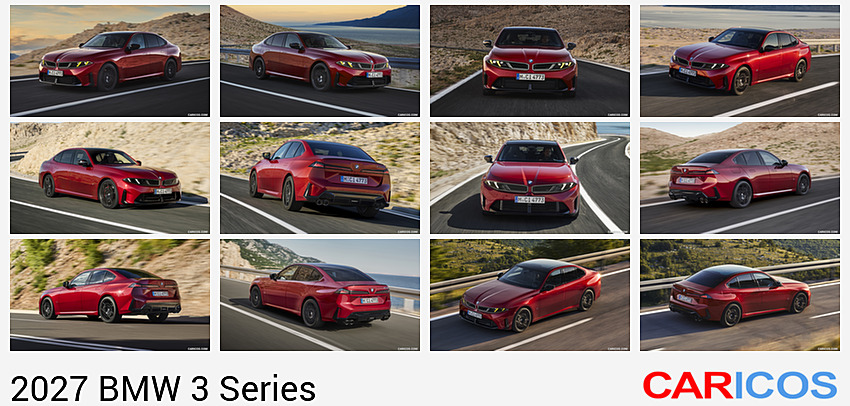
2027 BMW 3 Series Keeps Gasoline in the Picture
The 2027 BMW 3 Series moves into its eighth generation without abandoning the engines that helped establish its identity. BMW will offer two four-cylinder models and a stronger six-cylinder M350 xDrive, all with 48-volt mild-hybrid assistance. The bigger departure happens around those engines: a different face, a windshield-wide information display, and more extensive driving assistance. This is a substantial redesign, not simply a familiar sedan with a larger touchscreen.
The gasoline lineup shares its design direction and much of its cabin technology with the electric BMW i3, but the two use powertrain-specific chassis hardware and control systems. That distinction matters. Adopting the Neue Klasse appearance does not turn the combustion-powered 3 Series into an electric car with an engine substituted beneath the hood.
Three Gasoline Models and a $49,900 Starting Price
BMW plans to begin U.S. sales in the first quarter of 2027. The rear-wheel-drive 2027 BMW 330 starts at $49,900, while the 330 xDrive adds all-wheel drive for $51,900. The M350 xDrive sits above them at $65,900. Every model carries a $1,350 destination charge, bringing their starting totals to $51,250, $53,250, and $67,250, respectively, before options and taxes.
The accompanying electric model, the BMW i3 50 xDrive, starts at $61,500 before destination and produces 463 horsepower. BMW also plans an i3 M60 xDrive during 2027. Those cars warrant their own discussion, but their presence means buyers will choose between gasoline and electric propulsion within a visually related sedan family. BMW has already applied its Neue Klasse approach to the BMW iX3.
BMW also references future plug-in-hybrid 3 Series variants, although it has not provided a corresponding U.S. model specification, price, or launch schedule. For American buyers at launch, the combustion-engine choices remain the 330, 330 xDrive, and M350 xDrive.

The Six-Cylinder Gains More Than a New Badge
The 2027 BMW M350 xDrive pairs a turbocharged 3.0-liter inline-six with a 48-volt electrical system for 437 horsepower and 428 pound-feet of torque. That represents a 51-horsepower increase over the preceding six-cylinder model’s 386-horsepower rating. An electric starter-generator mounted within the transmission housing can contribute up to 17 horsepower. That assistance forms part of the powertrain’s operation, rather than an extra figure buyers should add to the advertised output.
BMW fits an eight-speed Steptronic Sport automatic and xDrive all-wheel drive as standard. The company quotes a 3.9-second run to 60 mph, or 3.6 seconds when the measurement excludes the first foot of movement. Keeping those two figures separate avoids making the acceleration claim look more generous than it is. With sport tires, the electronic speed limiter allows 155 mph. A model-specific exhaust terminates in four outlets.
The BMW 330 and 330 xDrive use a turbocharged 2.0-liter four-cylinder rated at 255 horsepower and 295 pound-feet. Their mild-hybrid system employs a belt-driven starter-generator, unlike the six-cylinder’s transmission-integrated arrangement. Both receive an eight-speed Steptronic automatic, and BMW lists the same 5.9-second 0–60 mph time for either drivetrain. Their maximum speed also reaches an electronically restricted 155 mph when buyers specify sport tires.
Across the gasoline range, BMW combines its TwinPower Turbo hardware with revised Valvetronic variable intake-valve lift and switchable exhaust valves. BMW says the latter arrangement cuts engine drag torque by approximately 66 percent, allowing the mild-hybrid system to recover more energy during deceleration and store it in the 48-volt battery.
All three engines use Miller-cycle combustion, which shortens intake-valve opening duration to improve efficiency. BMW also revises the intake passages, combustion chambers, camshaft timing, injection, ignition, and exhaust-gas routing. New turbochargers help account for the M350’s additional output. These are meaningful mechanical changes, although BMW has not announced EPA fuel-economy ratings for the gasoline models.
A Wider Face Without Oversized Kidneys
The new 3 Series measures 187.6 inches long, 72.8 inches wide, and 57.3 inches tall, with a 112.6-inch wheelbase. BMW lengthens the wheelbase and widens both tracks compared with the outgoing car. The electric i3 has slightly different dimensions, so the shared styling does not imply identical proportions.
The gasoline sedan retains a recognizable relationship between hood, cabin, and trunk, although its 2.5-box treatment softens the separation between the latter two. A rearward-positioned cabin, relatively short overhangs, prominent wheel arches, and a low body-side crease keep it from looking excessively tall. The rear shoulders supply much of the visual weight. Concealed window seals, including vertical seals tucked behind the window trim on gasoline models, reduce the number of visible interruptions.
Up front, BMW places the kidney shapes, headlights, and sensors within a broad, dark graphic. The kidneys stretch horizontally rather than dominating through height. I find that a more coherent approach: the grille and lamps finally look like parts of the same composition. Upright daytime-running-light elements retain a four-light identity and also serve the turn signals. The nose leans forward, while the BMW roundel occupies the small depression above the kidneys.
The M350 xDrive can add yellow front-light elements inspired by GT racing machinery and the BMW M Hybrid V8. BMW also offers illuminated kidney outlines through Iconic Glow, with the Iconic Glow exterior package standard on the M Performance model. Its Balanced, Relaxed, and Excited settings coordinate three lighting animations with exterior and cabin welcome and departure sequences. The illuminated grille is less restrained than the underlying design, but buyers can decide how much ceremony they want from a parked sedan.
At the rear, narrow lamps extend into the shoulders and use two elements per side to reinterpret BMW’s L-shaped lighting pattern in three dimensions. The badge again sits in a central recess. The M350 adds a standard trunk spoiler and four exhaust tips. Its dark lower bumper and diffuser look considerably busier than the upper body, though the contrast helps distinguish it from the four-cylinder cars.
Flush door handles extend as someone approaches. BMW will offer 11 exterior colors at launch, including the new Le Castellet Blue metallic across the family, along with solid, metallic, and Frozen finishes. Additional BMW Individual paint choices will follow during 2027.
Wheels and Packages Still Define the Details
Every gasoline-powered 2027 BMW 3 Series starts on 19-inch alloy wheels, with 20-inch alternatives available. The M350’s standard wheels use the Style 1139 M design in a two-tone Jet Black finish. Buyers can combine its optional 20-inch wheels with sport tires.
The optional M Sport package, standard on the M350 xDrive, adds model-specific bumpers, side skirts, and a rear diffuser through the M Aerodynamics package. Gasoline versions receive body-color side skirts. Blue-caliper M Sport brakes are an available upgrade within the package, while the M350 already includes M Sport braking hardware.
M Sport Professional brings black mirror caps, a black rear spoiler, and M Sport brakes with red calipers. It also provides another route to the M steering wheel and, on the four-cylinder gasoline cars, available Adaptive M Suspension. These packages change more than decoration, although their overlapping equipment makes careful configuration worthwhile.

The Chassis Changes Go Beneath the Styling
BMW revises the gasoline 3 Series body structure, suspension, steering, and braking system rather than relying solely on software to distinguish the new generation. The company describes weight distribution as close to even between the axles. It also changes the steering ratio and adjusts steering assistance according to the selected driving mode. An updated integrated braking system targets more consistent pedal response, finer modulation, and less operating noise.
The double-joint spring-strut front suspension gains positive caster trail and revised bushing behavior, while BMW reduces front-wheel camber. At the five-link rear axle, it changes negative caster trail and increases wheel camber. Higher-preload anti-roll-bar mounts at both ends and firmer chassis mounting points aim to improve body control and response. Standard suspension uses newly developed lift-related dampers.
The overall rolling diameter grows from 654 to 680 millimeters, approximately 25.7 to 26.8 inches. Wider inner rims also change how the tires meet the road. Available staggered 19- and 20-inch combinations use 245-millimeter front tires and 255-millimeter rear tires. A separate 20-inch sport-tire arrangement increases rear width to 275 millimeters.
Optional adaptive suspension and Adaptive M Suspension continuously adjust each wheel’s damping through electronically controlled valves. Both require variable-ratio sport steering. BMW says the systems improve transient response and reduce stopping distances under ABS braking. The regular adaptive setup offers Personal and Sport selections through My Modes.
The 2027 M350 xDrive includes Adaptive M Suspension, variable sport steering, an M Sport differential, xDrive, and M Sport brakes. Its Personal, M Sport, and M Sport Plus settings span comfort-oriented operation through the firmest performance configuration; the latter two modes belong specifically to the M350. BMW adds model-specific spring and damper calibration, a tower-to-front-end brace, and stronger anti-roll-bar mounting. The standard rear spoiler also reduces aerodynamic lift.
The gasoline cars use a dedicated BMW Driving Stack to coordinate handling functions, including all-wheel-drive behavior, while specialized controllers continue to manage engine operation and stability functions. They do not simply inherit the electric i3’s centralized Heart of Joy hardware. BMW uses that name more broadly as a driving-dynamics philosophy, but the technical implementation differs by powertrain.
A Rear-Drive Setting Arrives After Launch
BMW will add Drift Moment to the M350 xDrive during 2027, including through a software update for cars already delivered. Drivers activate it through the center display. The system then routes power exclusively to the rear wheels and uses M-specific multi-plate-clutch control alongside DSC Off operation.
That gives the M350 a controlled-slide setting previously associated with higher-performance BMW M machinery. It is not a feature for ordinary public-road driving, and its later arrival means early cars will not necessarily have it when customers take delivery. BMW reserves the function for M Performance models rather than the 330 range.
A Cleaner Cabin With Some Familiar Priorities
The dashboard trades a conventional instrument binnacle for a low, wide information strip beneath the windshield. Door-panel lines flow forward into the dash, and the central screen angles toward the driver. The resulting cabin looks less enclosed than the outgoing arrangement, even with the sizable display. A standard panoramic glass roof with climate-comfort glazing reinforces that impression.
BMW supplies power-adjustable front seats with memory and places their adjustment switches on the doors. The seatbacks include the Travel & Comfort accessory system for rear passengers. Optional multifunction seats add lumbar and backrest-width adjustment, plus ventilation in gasoline models. The electric i3’s massage function does not carry over to these combustion-engine seats.
The M350 xDrive can instead use M Sport seats with larger side bolsters and illuminated M emblems high in the backrests. Those logos remain visible through the glass, adding another decorative element to an otherwise fairly orderly interior.
Three cabin themes organize the upholstery choices. Contemporary uses synthetic Veganza in Digital White, Castanea, Agave Green, or Black. The BMW M treatment combines Black Veganza with M PerformTex, while BMW Individual supplies Black Merino leather. Buyers can specify the M350’s optional M Sport seats in Black within the Individual arrangement. A white BMW Individual steering wheel accompanies only the Digital White Contemporary interior.
The standard steering-wheel design places a spoke at the top of its center section and includes pronounced thumb supports. The M350 takes a different approach with a flattened M wheel and lower spokes at roughly four and eight o’clock. Other models can add that wheel through the M Sport or M Sport Professional packages. All gasoline versions include shift paddles.
Electric door releases serve front and rear occupants. The console holds a transmission selector, a storage area, and wireless phone charging with a magnetic holder. There’s still physical buttons for the parking brake, rear defroster, hazard lights, and audio volume. Their presence is welcome, even as more secondary functions migrate into menus.
Two-zone automatic climate control comes standard. Electrically adjusted vents offer direct or indirect airflow through a QuickSelect shortcut, while three-zone climate control and heated rear seats remain optional. Electrifying vent adjustment adds another screen-mediated task to what used to be a simple manual action, a small trade-off within the cleaner dashboard.

The Windshield Becomes the Instrument Panel
BMW Panoramic iDrive combines four main components: Panoramic Vision, the multifunction steering wheel, a 17.9-inch central touchscreen, and an available 3D head-up display. BMW Operating System X coordinates them. Together, they replace the need for a separate instrument screen behind the wheel.
Panoramic Vision projects information across the lower windshield area and remains readable through polarized sunglasses. Driving data stays nearest the driver, while occupants can personalize the central and passenger-side content. Users can drag as many as six widgets from the touchscreen into the panoramic display, including larger formats that give selected information more space. They can change views through either the screen or steering-wheel controls.
The optional 3D head-up display sits visually above that lower projection and supplies spatial navigation instructions and assistance-system information. BMW coordinates the two projection areas to avoid treating them as unrelated displays.
The central touchscreen has an irregular outline, matrix backlighting, and QuickSelect access to commonly used functions. Steering-wheel assistance and parking controls illuminate only when their functions become available, while infotainment controls provide haptic feedback. Wireless Apple CarPlay and Android Auto come standard. BMW has also sought patents for several elements of the display and operating system, although patent applications alone say little about everyday usability.
Profiles, Voice Commands, and a Growing App List
Operating System X uses the Android Open Source Project as its foundation and supports continuing software updates, including optional automatic installation. Drivers can change colors, layouts, widgets, and backgrounds, upload personal pictures through the My BMW App, and let interface colors adapt to those pictures. Up to seven BMW IDs can retain individual settings, with a name and optional profile picture greeting each user.
My Modes coordinates display appearance, ambient lighting, sound, and powertrain behavior. Alongside model-specific performance settings, BMW lists Sport, Efficient, Silent, and a customizable Personal mode. The lighting and screen graphics work together rather than behaving as separate cabin features.
The Intelligent Personal Assistant responds through a steering-wheel button or its spoken activation name. It can manage navigation, media, calls, windows, climate settings, seat-comfort functions, selected apps, and vehicle menus. Amazon Alexa+ adds generative-AI dialogue and access to outside information and cloud services. Linking an Amazon account enables additional music searches, streaming, news, and other content.
BMW also lets drivers build routines around time, temperature, occupancy, and other conditions. One routine could combine steering-wheel heating, seat heating, and defrosting. The assistant can suggest actions using previous behavior, the current driving situation, environmental information, and cabin sensing.
The standard 330 audio system uses seven speakers and 205 watts. The M350 includes Harman Kardon audio, and available Harman Kardon configurations add speakers, greater output, and Dolby Atmos playback for compatible recordings.
For parked entertainment, the TiVo-powered Video app provides news, live programming, and on-demand services, with Amazon Prime Video also joining the offering. Users can sign into existing accounts and continue programs started elsewhere. AirConsole games include UNO Car Party! and Hot Wheels: Xtreme Overdrive, using phones as controllers. Boosteroid adds cloud gaming, including Forza, and selected games support Bluetooth console controllers. BMW’s ConnectedDrive Store already carries more than 60 apps worldwide across entertainment, news, audio, and travel categories.
Connected Features Bring Another Optional Package
BMW Digital Premium supplies entertainment data through the car’s 5G-ready telematics hardware. Without it, users can connect through a phone hotspot or Wi-Fi. The package also expands BMW Maps with live traffic, satellite imagery, 3D buildings, parking details, and proactive route suggestions. Google Places contributes business information, reviews, and other point-of-interest details.
Security Assistant can send My BMW App notifications following an attempted theft or parking impact. Drive Recorder makes exterior accident footage available for export, while the theft and parking-collision recorder can save video automatically. Optional Remote Inside View and Remote 3D View let owners inspect the cabin and surrounding area from their phones.
Digital Premium also includes M-oriented apps. M Cockpit creates configurable displays of vehicle and driving-dynamics data, M Drag Meter records acceleration information, and M Channel provides motorsport programming. BMW can expand the package after purchase.
ConnectedDrive Upgrades offer another means of adding eligible features later. Depending on the product, activations can last a month, a year, or the vehicle’s lifetime, and many include a trial. Owners can manage them through the vehicle, app, or online store. It is worth separating these services from standard equipment when comparing prices.

Hands-Free Assistance Still Needs an Attentive Driver
Every new BMW 3 Series includes Driving Assistant Plus, combining adaptive cruise control with stop-and-go operation, speed-limit assistance, lane-keeping assistance, and steering assistance. BMW’s Symbiotic Drive approach allows drivers to apply steering, braking, or acceleration without automatically canceling assistance.
The system also evaluates steering behavior and gaze direction to distinguish a deliberate lane departure from an accidental one. Turn-signal use, steering input, and a shoulder check can indicate intent. BMW intends the lane-keeping system to avoid unnecessary intervention when the maneuver presents no foreseeable collision or road-departure risk.
Standard safety equipment includes lane-change warnings, side-collision warnings with steering intervention, crossing-traffic warnings with emergency braking, and emergency braking with evasive assistance. BMW adds enhanced emergency steering around detected obstacles and improved sensing for wildlife. Exit warning can actively delay an electric door release when an approaching cyclist creates a risk.
Optional Highway Assist permits hands-free operation on suitable limited-access highways at speeds up to 85 mph. It remains an SAE Level 2 system: the driver must watch the road and remain responsible for the car. On supported roads and in selected areas, BMW Maps integrates the vehicle, detected surrounding objects, lane positioning, navigation guidance, and assistance graphics into a single 3D view. Mapbox supplies mapping technology for this BMW-developed presentation, and availability will expand gradually.
Park Assist can start from a steering-wheel control and uses AI-supported space recognition and maneuver planning. Parking Assistant Plus adds a 360-degree camera presentation with curb, 3D, and car-wash views. Maneuver Assistant can learn and repeat routes up to 650 feet long. Parking Assistant Professional adds app-based remote parking and stored maneuvers from as far as 20 feet away. BMW also plans post-purchase activation of assistance features through ConnectedDrive.
A Different Factory for the Gasoline Sedan
BMW will begin building combustion-powered 3 Series sedans at Dingolfing, Germany, in November 2026. The model returns to a plant that first produced the 3 Series in 1980. Dingolfing also manufactures the BMW 4 Series, BMW 5 Series, their M variants, and the BMW 7 Series, using flexible production arrangements that accommodate different models and powertrains.
The Austrian Steyr plant supplies the gasoline engines. Meanwhile, Munich builds the electric i3 and will switch entirely to electric-vehicle production in 2027. That manufacturing split underlines the new generation’s central distinction: related design and technology, but different engineering and production paths. The broader 3 Series family has surpassed 18 million sales since its 1975 debut.
New Screens, Familiar Mechanical Choices
The 2027 BMW 3 Series gives gasoline buyers a substantial update rather than relegating them to an older model beside a newer EV. The 330 models preserve a relatively straightforward four-cylinder choice, while the M350 xDrive adds considerably more power, comprehensive chassis equipment, and a forthcoming rear-drive setting. I prefer the calmer proportions of the exterior to its animated lighting flourishes. Inside, the panoramic display represents the greater adjustment. BMW has retained some useful physical controls, but this remains a more software-dependent sports sedan, even when an inline-six supplies the soundtrack.
-Ed
 2027 BMW 3 Series