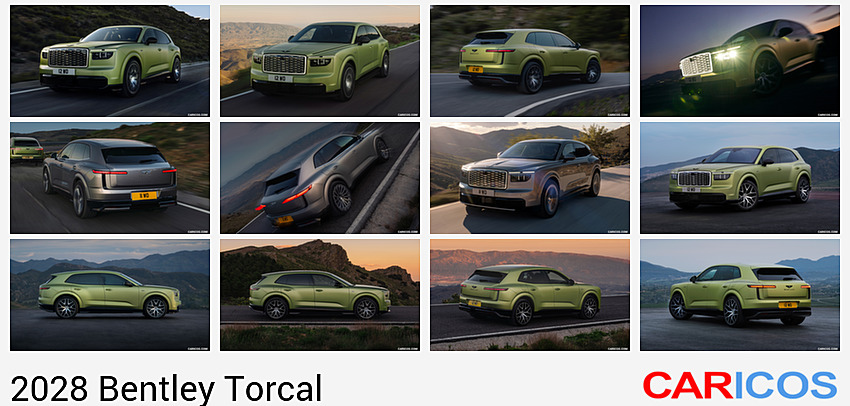
2028 Bentley Torcal Goes Electric Without Going Minimalist
The 2028 Bentley Torcal gives the British automaker its first fully electric production model, but it does not trade wood, elaborate upholstery, or physical controls for a stripped-down cabin. Bentley debuted the SUV in London on September 23, 2026, establishing a fourth model line alongside its existing gasoline and hybrid offerings. Two versions, the standard Torcal and the sportier Torcal S, arrive with all-wheel drive, an unusually elaborate active suspension, and as much as 876 horsepower.
Bentley designed and engineered the Torcal in Crewe, where it will also build the vehicle with support from suppliers across the United Kingdom. The investment extends beyond a new powertrain: its styling, materials, and cabin technology set a direction for subsequent Bentleys, including those that retain an engine.
Two Outputs and One Important Qualifier
The standard 2028 Torcal produces approximately 810 hp and 881 lb-ft of torque, enough for Bentley to quote a 3.3-second run to 60 mph and a 155-mph maximum speed. The Torcal S raises those figures to approximately 876 hp and 996 lb-ft, with a claimed 2.8-second sprint and a 162-mph ceiling. Its maximum output requires Launch Control, an important qualification to the headline numbers. For the corresponding 0-100 km/h acceleration tests, Bentley lists 3.4 seconds for the core model and 2.9 seconds for the S.
Bentley says it deliberately stopped short of pursuing even more abrupt acceleration because many customers find that sensation uncomfortable. That is a reasonable distinction for a luxury SUV, although 2.8 seconds hardly represents restraint. The S also delivers more torque than any previous Bentley.
Both versions use two permanent-magnet synchronous motors. Each has a dry-sump lubrication system with oil intended to last the unit’s service life. An open differential serves the front axle, while the rear combines a locking differential with a multi-plate clutch on each output shaft.

Fast Charging and a Range Figure With Context
A battery containing 192 lithium-ion pouch cells connected in series provides 113 kWh of usable capacity and operates at a nominal 800 volts. Bentley backs it with a 10-year, 100,000-mile warranty.
The company quotes up to 375 miles of range under the WLTP testing procedure. That is not an EPA estimate, so American shoppers should not treat it as a directly comparable U.S. range rating. At a compatible charger supplying up to 400 kW, Bentley claims a best-case 10-to-80-percent session of 16 minutes, comfortably within its broader sub-20-minute target. It also quotes approximately 100 miles of additional range in seven minutes.
Those charging figures depend on suitable equipment and battery conditions. They nevertheless explain an important part of the Torcal’s engineering brief: making a large electric Bentley useful beyond short trips, rather than simply giving it impressive acceleration.
A Suspension That Works Each Corner
The Torcal brings fully active suspension to Bentley for the first time. Working with adaptive two-valve dampers, the system can raise or lower each corner independently in response to the road and the driver’s inputs. It also generates the forces needed to resist body roll, eliminating conventional anti-roll bars and allowing the control system to vary roll resistance continuously.
Standard all-wheel steering turns the rear wheels by as much as five degrees. Bentley quotes a turning circle of approximately 36.4 feet, or 11.1 meters, a useful number for a vehicle nearly 197 inches long. Different drive modes change the chassis calibration rather than leaving this hardware to deliver one fixed interpretation of comfort.
Standard iron brake rotors measure 16.5 inches, or 420 mm, at the front and 14.6 inches, or 370 mm, at the rear. An optional carbon-silicon-carbide ceramic setup increases those diameters to 17.3 inches, or 440 mm, and 16.1 inches, or 410 mm. Bentley describes the larger front discs as jointly the world’s largest alongside those on other Bentley models. Buyers can choose black, red, or gray calipers, with Mulliner offering three additional colors.
Bentley’s stated targets span Flying Spur-like comfort, Continental GT Speed-like handling, and composure away from paved roads. Those are engineering ambitions rather than driving impressions, but they show why the suspension receives nearly as much attention as the motors.
A Different Face Without an Unfamiliar Shape
Under design director Robin Page, Bentley has given the Torcal a relatively low roof, a long wheelbase, and short overhangs while preserving a substantial hood and upright nose. That hood is a visual link to the company’s front-engine cars rather than a requirement imposed by an electric motor. The proportions make the SUV look more like an evolution of Bentley’s existing vocabulary than an attempt to disguise its origins.
The front lighting provides the clearest departure. Thin horizontal strips sit above deeper, rectangular lamp housings, replacing the familiar impression of separate round headlights. Between them, an illuminated diamond-pattern grille remains emphatically large. Bentley references the Continental T in the face, although the lighting treatment gives the Torcal its own expression.
The rear works better through restraint. Narrow lamps, a broad tailgate, and dark vertical framing establish a shield-like outline that develops an idea from the Bentley EXP 15 Concept Car. The cabin narrows toward the back, leaving pronounced shoulders over the rear wheels. Relatively few creases interrupt the body sides, so those changes in volume do most of the visual work.
Diamond motifs reappear in smaller exterior and interior details rather than staying confined to the grille. The Torcal also becomes the first Bentley to wear the revised winged emblem that the company revealed in 2025. Overall, the shape looks contemporary without depending on a steeply sloping, coupe-style roof to make its point.

How the Core Torcal and Torcal S Differ
The core model pairs satin-silver exterior trim with a single-tone cabin treatment and Open Pore Crown Cut Walnut. It rides on 21-inch wheels as standard. The S substitutes a 22-inch design with ten pairs of spokes.
There's three additional optional 22-inch wheel designs, including one that prioritizes aerodynamics. Bentley offers five designs altogether in multiple finishes. Summer and winter tires come in both 21- and 22-inch sizes, while buyers seeking all-season tires get a 22-inch option.
The Bentley Torcal S makes its identity clear through black exterior trim and mirror caps, darkened rear lights, a rear diffuser, reshaped sport sills, and front-bumper strakes. Red brake calipers, S fender badges, and black winged Bentley badges complete the exterior changes.
Inside, the S receives its own color arrangement, quilting, and stitching, plus sport pedals and standard Piano Black veneer. Illuminated sill plates and moving waterfall-style ambient lighting add further separation from the core car. The extra performance therefore comes with a fairly comprehensive appearance package, not merely different software.
A Cabin That Leaves Room for Materials
The dashboard retains a wing-inspired layout, with broad trim panels extending outward from the center stack. A rising console, circular vents, and metallic borders give the cabin structure without turning every surface into a display. Wood, leather, wool, and aluminum remain prominent, and the diamond quilting adds detail without obscuring the larger shapes.
Knurled switches and a new interpretation of Bentley’s bullseye vents preserve familiar touch points. Physical controls remain on the center console and steering wheel. Keeping them is a welcome decision in a cabin that otherwise adds plenty of electronic functionality.
The new seats include 16-way adjustment, heating, ventilation, adjustable bolsters, and a revised massage system as standard equipment. Optional Postural Adjust changes the seat’s shape to redistribute pressure during longer drives. Smart Seat Climate automatically regulates heating and ventilation around an occupant’s selected temperature. The dedicated Wellness Seat Specification extends massage into the seat cushion, reaching the legs as well as the back and shoulders.
A three-person rear bench gives the Torcal a five-seat layout and introduces power-folding rear seats to Bentley. Despite measuring approximately 196.9 inches long, making it the shortest four-door in the lineup, the SUV provides a quoted 16.2 cubic feet of rear luggage space and another 3.2 cubic feet beneath the hood. A Frosted Diamond switchable-glass sunroof lets occupants change the amount of light entering the cabin.
Wool, Walnut Off-Cuts, and a Long Color List
The Torcal’s material choices include a fabric developed with Fox Brothers, the Somerset textile manufacturer whose history stretches back to the 18th century. Bentley says their collaboration produced the first automotive fabric made entirely from Merino wool, addressing the durability requirements that previously limited its use in cars. It also identifies the material as the first automotive wool fabric certified to the Responsible Wool Standard.
Mulliner’s new Ombré Walnut takes a different approach to traditional wood trim. Craftspeople combine as many as 1,000 selected layers of responsibly sourced walnut off-cuts and recycled craft paper, press them together, and slice the resulting material into sections less than a millimeter thick. Four walnut shades create a graduated finish that passes through deep black, dark smoke, and light smoke tones.
Another Mulliner option, Sunburst Aluminium, uses a three-direction brushed pattern to reinterpret the engine-turned metal dashboards of older Bentleys. It offers a more visibly technical alternative to wood without abandoning a textured surface.
The wider upholstery selection includes 15 colors of olive-tanned leather, with Teal, Terra, and Glaze joining the palette. Buyers can specify 15 corresponding Dinamica shades or five Merino wool colors. Six wood veneers and two technical finishes sit alongside six Piano finishes: Black, Gravity Grey, Linen, Teal, Imperial Blue, and Cricket Ball. Sustainability here involves identifiable changes to sourcing and material use, rather than simply replacing leather with one alternative.

Four Modes Reach Beyond the Accelerator
The 2028 Bentley Torcal’s four Experience Modes coordinate lighting, sound, climate, airflow, and displayed information as well as the driving settings. Bentley Mode serves as the balanced default, maintaining a driver-oriented layout without adopting the more assertive responses of Sport.
Comfort reduces visual distractions and offers a setting that hides all but essential digital information. Sport increases the prominence of the propulsion soundtrack and changes the lighting, visual cues, and control responses. Refresh increases fresh-air circulation and brightens the cabin lighting. These are broader cabin presets, not just four labels attached to an accelerator map.
Bentley-specific curved OLED screens provide deep blacks and strong color contrast, with their shape intended to improve access across the displays. Facial recognition identifies the driver and loads preferences such as seat position, steering-wheel adjustment, and driver-assistance settings. A compatible phone can also function as the Mobile Device Key, providing the vehicle’s access and key functions.
An augmented-reality head-up display places navigation directions and driver-assistance markers in the driver’s forward view. It aligns those graphics with relevant turns or hazards, aiming to reduce the need to look down at another screen.
Parking Assistance Extends to the Doors
A total of 25 radars, sensors, and cameras supports the Torcal’s assistance systems. Among the more unusual functions, the vehicle can identify a passing place while traveling along a narrow road, then automatically reverse to that location if it encounters an obstruction. Bentley also includes assistance for towing, garage parking, and parallel parking, with functions intended to help protect the wheel rims.
Owners can initiate remote parking through an app or teach the vehicle a particular parking maneuver. These capabilities add convenience, though they remain assistance features rather than a claim of unrestricted autonomous driving.
All four doors use radar-controlled power operation to open and close. Passengers can trigger closing by fastening their seat belts or using the main touchscreen; the driver can also close the driver’s door by pressing the brake pedal. It is an unusually thorough attempt to automate the routine of getting into a car.
A V8 Rhythm Without the Engine
Sound has accompanied Bentley’s identity from the 1919 Bentley 3 Litre through its long-running 6.75-liter V8. For the electric Torcal, the company commissioned musicians to develop a propulsion soundtrack using instruments including drums, viola, and bass guitar. The resulting Bentley Dynamic Symphony draws on the rhythm of that V8 rather than simply playing a synthesized copy of its exhaust note.
The low-frequency composition retains small variations from the musicians’ performances and responds to requested torque and vehicle speed. Sport mode increases its volume, while drivers who prefer an electric vehicle’s quieter character can switch it off entirely. That last choice matters more than any elaborate explanation of the soundtrack.
Smaller sounds also have physical origins. Bentley recorded a hammer striking leather in its upholstery workshop for the turn signals, while sounds associated with the touchscreen and digital assistant come from a crystal glass.
For music, the standard system supplies 620 watts through 16 speakers. The optional Naim installation increases output to 1,780 watts and uses 28 speakers, including speakers in the front headrests. It also adds tactile seat shakers and Dolby Atmos 7.1 audio.

Familiar Priorities, Different Machinery
U.S. pricing, an EPA range rating, and a specific U.S. on-sale date remain unspecified for the 2028 Bentley Torcal. The known specifications establish a fast, heavily equipped electric SUV, but its more distinctive choices sit beyond the acceleration figures: individually controlled suspension, extensive seat adjustments, retained physical switches, and a cabin that makes room for textiles and timber.
Not every addition feels essential, particularly the expanded collection of sounds and mood settings. Still, Bentley has avoided making electrification synonymous with removing familiar luxuries. The Torcal changes what drives the vehicle while leaving much of what defines its cabin deliberately recognizable.
-Ed
 2028 Bentley Torcal